Table of Contents
- Can You Drive a Rental Car to the Blue Lagoon in Akamas?
- The Reality of the Akamas Peninsula Road Conditions
- Getting There by Car: Route Logistics and Parking
- Hiring an Akamas 4×4: The Only Safe Way to Drive
- Comparing Transport Options to Blue Lagoon Cyprus
- The Latchi Boat Trip Experience
- Alternative Ways to Reach the Blue Lagoon
- Essential Tips for Visiting the Akamas National Park
- Best Time to Visit to Avoid the Crowds
- Frequently Asked Questions About the Blue Lagoon
The short answer is no: you can’t legally or safely drive a standard rental car to the Blue Lagoon in the Akamas Peninsula. Most rental contracts in Cyprus now explicitly ban it, and the road conditions would punish any regular hatchback or saloon. But that doesn’t mean you can’t get there. Several reliable options exist, from boat trips out of Latchi to 4×4 hire and even hiking. This guide breaks down every route, every risk, and every practical alternative so you can plan your visit with confidence.
Can You Drive a Rental Car to the Blue Lagoon in Akamas?
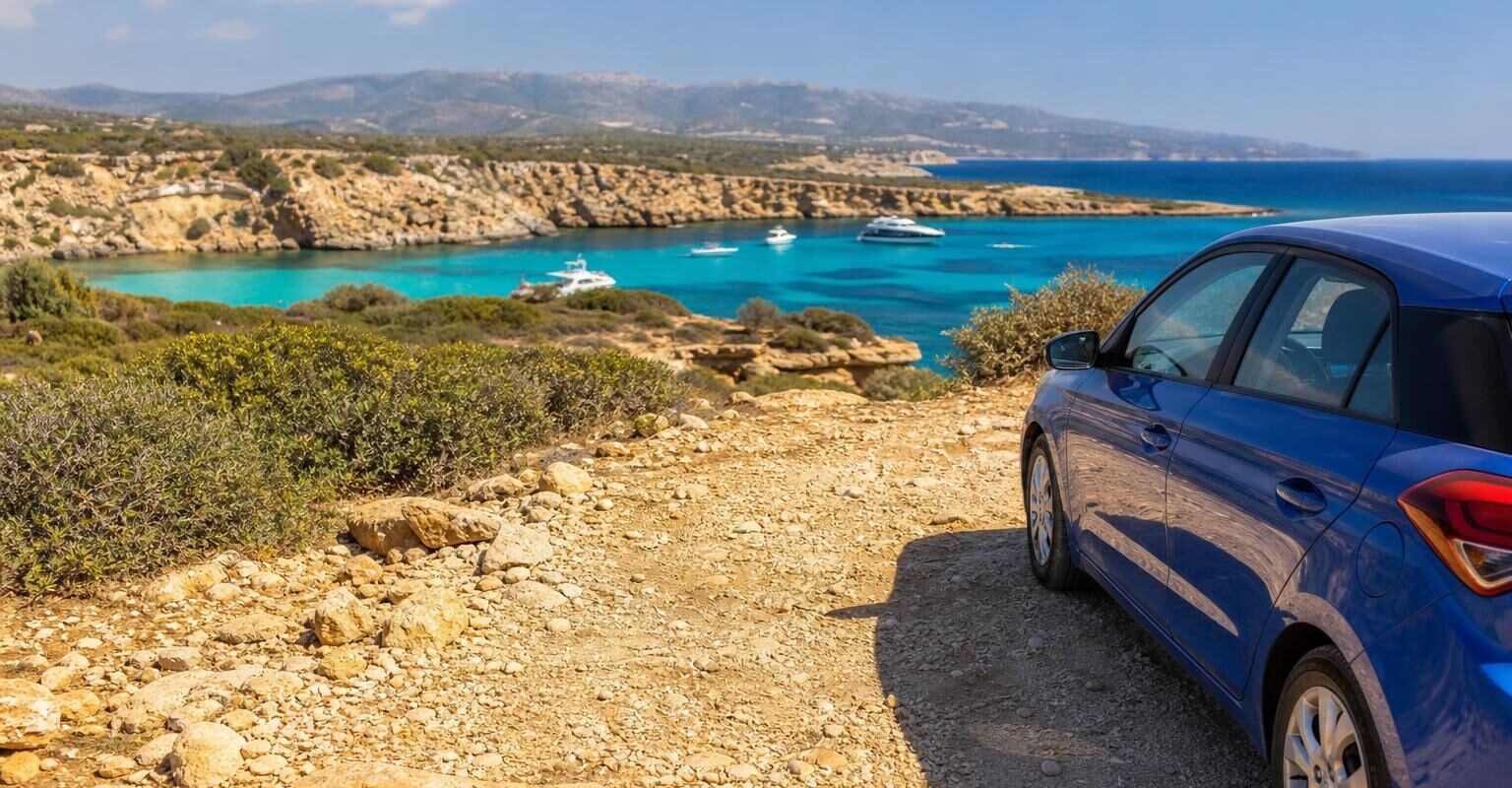
No. Standard rental agreements in Cyprus now include a prohibited-area list that specifically names the Akamas National Forest Park and Blue Lagoon. Driving there in a regular hire car isn’t just inadvisable: it’s a breach of contract.
The consequences are real. Violating the Akamas exclusion zone can trigger an immediate fine of around €450 from your rental company, with additional charges of roughly €20 per kilometre driven off asphalt. Any damage to the vehicle’s undercarriage, tyres, or suspension on the unpaved tracks won’t be covered by your insurance. You’ll pay the full repair bill out of pocket.
This isn’t a vague guideline buried in the small print. Rental agents at the desk will tell you directly, and the GPS tracking fitted to most modern fleet vehicles makes it straightforward for companies to verify where you’ve been. If you’re renting a car in Cyprus for a holiday, the Akamas dirt roads are the single most common reason travellers face unexpected charges.
⚠️ Warning: Since May 2026, a team of 16 trained park rangers has been patrolling the Akamas Peninsula to enforce environmental regulations. Unauthorised vehicles on restricted tracks can be stopped and reported.
The Reality of the Akamas Peninsula Road Conditions
The track from the Baths of Aphrodite to the Blue Lagoon is roughly 7 km of unpaved, rocky terrain. It’s not a gentle gravel road. Sections feature loose boulders, deep ruts carved by winter rain, and steep gradients with no barriers. Even in dry summer conditions, the surface is punishing.
The route passes through the Fontana Amorosa section, which the Environmental Authority approved for “minimum necessary improvements” in April 2026. Construction on Phase A/C is scheduled for Q4 2026, but these upgrades are designed for conservation access, not standard tourist traffic. Don’t assume the road will be smooth by the time you visit.
Why Standard Rental Insurance Won’t Cover You
Rental insurance in Cyprus, whether basic CDW or full cover, contains exclusion clauses for off-road driving. The moment your wheels leave a paved surface, your policy is void. This applies to every major rental company operating on the island.
Even “super cover” or “zero excess” add-ons purchased at the desk or through third-party providers typically exclude unpaved roads. Read the policy document carefully. If it mentions “metalled roads only” or “paved surfaces,” that’s your answer. The Akamas tracks are categorically off-road.
Damage from these routes tends to be expensive. Cracked sumps, punctured tyres, bent wheel rims, and damaged exhaust systems are the most common issues. Repair costs for undercarriage damage on a typical hire car can easily reach €800 to €1,500.
The Dangers of Driving a Small Hatchback to the Lagoon
A Fiat Panda or Toyota Yaris has roughly 150 mm of ground clearance. The rocks on the Akamas track regularly sit 200-300 mm above the surface. The maths doesn’t work.
Beyond clearance, small hatchbacks lack the suspension travel, tyre sidewall depth, and low-range gearing needed for this terrain. You’ll scrape the undercarriage within the first kilometre. Overheating is another risk: crawling in first gear on a 35°C day puts enormous strain on a small engine and cooling system.
There’s also the question of getting stuck. If you beach the car on a rock or sink into a soft patch, recovery services charge a premium for Akamas call-outs. You could be waiting hours. Mobile signal is patchy throughout the peninsula, which makes calling for help unreliable.
Getting There by Car: Route Logistics and Parking
If you do have an appropriate vehicle (more on that below), the most common driving route starts from Latchi harbour. Head north-east on the coastal road toward the Baths of Aphrodite, then take the signed dirt track westward toward Fontana Amorosa and the lagoon.
- Starting point: Latchi (Lakki), Paphos District
- Distance to the Blue Lagoon: approximately 12 km via the Baths of Aphrodite track
- Drive time: 45-60 minutes (the rough surface forces speeds below 15 km/h in places)
- Road condition: unpaved, 4×4 only
- Parking: extremely limited at the lagoon itself
New regulations introduced in 2026 prohibit on-road parking throughout the Akamas forest road network to keep routes clear for firefighting and emergency vehicles. This means you can’t simply pull over and leave your car on the verge. Designated parking areas are small and fill quickly in summer, especially between 10:00 and 14:00.
📝 Note: Parking enforcement in Akamas is active. Rangers patrol the tracks and can issue penalties for vehicles parked outside designated areas. Arrive early or choose a different transport method during peak season.
Hiring an Akamas 4×4: The Only Safe Way to Drive
If you’re set on driving to the Blue Lagoon yourself, you’ll need a proper 4×4 with off-road clearance, and a rental agreement that explicitly permits unpaved roads. Not every 4×4 rental in Cyprus includes off-road cover, so you need to ask directly.
Look for these specifics when booking:
- Confirmation that the Akamas Peninsula is not on the prohibited-area list
- Off-road or “unsealed surface” insurance included in the policy
- A vehicle with at least 200 mm ground clearance (Suzuki Jimny, Jeep Wrangler, or similar)
- Spare tyre in good condition and a basic tool kit
Expect to pay significantly more for a 4×4 with off-road permissions than for a standard hire car. Daily rates for suitable vehicles typically run two to three times higher than a compact hatchback. Check prices directly with rental providers: rates shift seasonally and availability is limited during July and August.
CyprusCarRental’s booking platform lets you filter by vehicle type, which helps if you’re specifically looking for 4×4 options with the right coverage.
Comparing Transport Options to Blue Lagoon Cyprus
Choosing how to reach the lagoon depends on your budget, fitness level, and how much time you want to spend there. Here’s a direct comparison of the main options available in 2026:
| Option | Cost (approx.) | Travel Time | Time at Lagoon | Best For |
|---|---|---|---|---|
| Boat from Latchi | €20-38 per person | 20-30 min each way | 1-2 hours | Families, groups, ease |
| 4×4 rental (off-road cover) | €80-150/day | 45-60 min each way | Flexible | Independent travellers |
| Guided jeep safari | €50-80 per person | Full day | 30-60 min | First-time visitors |
| Hiking from Baths of Aphrodite | Free | 2-3 hours each way | Flexible | Fit hikers |
| E-bike or quad | €40-70/day | 1-1.5 hours each way | Flexible | Active travellers |
Prices are approximate for 2026 and vary by operator and season. Always confirm current rates before booking.
The Latchi Boat Trip Experience
The boat trip from Latchi harbour is the most popular way to visit the Blue Lagoon in Cyprus, and for good reason. It removes every headache associated with the road: no vehicle damage, no parking stress, no insurance worries.
Several operators run daily departures from Latchi between April and October. Most trips last three to four hours and include a stop at the lagoon for swimming, plus a second stop at a nearby sea cave or quiet cove. Larger boats carry 30-50 passengers, while smaller vessels offer more intimate trips for 10-15 people.
The water at the lagoon looks its most striking from the sea. The turquoise colour comes from the white sand and limestone seabed, and it’s genuinely impressive on a clear day. Boats typically anchor 20-30 metres offshore, and you swim or snorkel from the vessel.
Book ahead in July and August. Morning departures (09:00-10:00) tend to arrive before the lagoon gets crowded with other boats. Afternoon trips are usually cheaper but busier.
Alternative Ways to Reach the Blue Lagoon
Guided Jeep Safaris from Paphos and Latchi
Jeep safaris are a well-established way to explore the Akamas peninsula without the responsibility of driving yourself. Operators use Land Rovers or similar vehicles with experienced local drivers who know the tracks intimately.
Most full-day safaris depart from Paphos or Latchi, cover the Blue Lagoon, Fontana Amorosa, and several viewpoints along the coast. Lunch is usually included. The trade-off is time: you’ll spend only 30-60 minutes at the lagoon itself because the tour covers multiple stops.
Half-day options exist too, focusing specifically on the lagoon and the surrounding coastline. These give you more time in the water but less of the wider peninsula.
Hiking the Coastal Path from Baths of Aphrodite
The Aphrodite Trail and connecting coastal paths lead from the Baths of Aphrodite to the Blue Lagoon. It’s a serious walk: roughly 7-8 km each way with limited shade, rocky footing, and some steep sections.
Carry at least two litres of water per person. In summer, temperatures along this exposed coast regularly exceed 38°C by midday. Start early: 06:00 or 07:00 departures give you the best chance of reaching the lagoon before the heat peaks.
The trail is free and doesn’t require any booking. It’s well marked but not maintained to a high standard, so sturdy hiking shoes are essential. Flip-flops or trainers won’t cut it on the rocky sections.
💡 Pro Tip: If you hike in, arrange a boat pickup from the lagoon back to Latchi. Some operators offer one-way transfers. This saves you the brutal return walk in the afternoon heat.
Exploring Akamas by E-Bike or Quad
E-bikes and quad bikes can be hired in Latchi and Polis Chrysochous. Both handle the Akamas tracks reasonably well, though quads cope better with the roughest sections.
E-bikes with fat tyres are increasingly popular for the route. The electric assist takes the edge off the climbs, and you can cover the distance in about 90 minutes each way. Battery range is worth checking: you’ll need a minimum 60 km range to complete the return trip comfortably.
Quad hire usually requires a full driving licence (Category B). Helmets should be provided. Ride cautiously: the tracks have blind corners and other vehicles, including tour jeeps, use the same routes.
Essential Tips for Visiting the Akamas National Park
The Akamas Peninsula is a protected nature reserve, and the rules in 2026 reflect that status. Rangers are active, regulations are enforced, and the area is managed more tightly than it was even two years ago.
Practical essentials to keep in mind:
- No camping or fires anywhere in the park
- No collecting plants, rocks, or marine life
- No drone flying without a permit from the Civil Aviation Authority
- Carry all rubbish out with you: there are no bins at the lagoon
- Dogs must be on leads at all times
Sun protection is critical. The coast has almost no natural shade, and the water reflection intensifies UV exposure. Bring reef-safe sunscreen (the lagoon’s ecosystem is fragile), a hat, and UV-protective clothing.
Mobile signal is unreliable across much of the peninsula. Download offline maps before you set out, and tell someone your plans if you’re hiking alone.
Best Time to Visit to Avoid the Crowds
The Blue Lagoon is busiest from mid-June to mid-September, with peak congestion in July and August. During these months, the lagoon can have 15-20 boats anchored at once by midday. The water is still beautiful, but the experience is less peaceful.
For a quieter visit, aim for late April to early June or mid-September to late October. Water temperatures are comfortable for swimming from May onwards (around 21-22°C, rising to 27-28°C by August). The shoulder months offer warm air, fewer boats, and calmer conditions.
Weekday mornings are consistently less crowded than weekends, regardless of season. If you’re taking a boat from Latchi, the first departure of the day almost always delivers the best experience.
Winter visits (November to March) are possible by 4×4 or on foot, but swimming is cold and boat services don’t operate. The landscape is greener, though, and you might have the lagoon entirely to yourself.
Frequently Asked Questions About the Blue Lagoon
Is the Blue Lagoon in Cyprus worth visiting?
Yes. The water clarity and colour are genuinely striking, and the setting along the Akamas coast is dramatic. It’s one of the most photogenic spots on the island. Go early in the day or in shoulder season for the best experience.
Can I swim at the Blue Lagoon?
Absolutely. The water is shallow near the shore (1-2 metres) and deepens further out. There are no lifeguards, so swim within your ability. The seabed is sandy with some rocks, and snorkelling is excellent in the surrounding area.
How much does a boat trip to the Blue Lagoon from Latchi cost?
Prices in 2026 typically range from €20 to €38 per person for a half-day trip. Private boat charters cost significantly more. Prices vary by operator, boat size, and season: always confirm before booking.
Do I need to book the Blue Lagoon boat trip in advance?
During July and August, yes. Walk-up spots are often available in shoulder season, but booking a day ahead is still sensible, especially for morning departures.
Is there food or drink available at the Blue Lagoon?
No. There are no facilities at the lagoon itself: no toilets, no shops, no restaurants. Bring everything you need, including water, snacks, and sunscreen. The boat trips usually include drinks and sometimes a light lunch.
The Blue Lagoon is one of the most rewarding day trips you can make from the Paphos coast, but getting there requires a bit of planning. A standard rental car simply isn’t an option for the Akamas tracks. Choose a boat from Latchi for convenience, hire a proper off-road vehicle if you want independence, or lace up your hiking boots for the full adventure. Whichever route you pick, start early, pack plenty of water, and respect the national park rules that keep this stretch of coastline worth visiting.