
Table of Contents
- The Enigma of Varosha: Cyprus’s Frozen Shoreline
- The History of the Famagusta Ghost Town Since 1974
- Planning Your Visit: Can You Visit Varosha Today?
- Getting to Varosha from the South
- Getting There by Car: Practical Logistics
- Essential Insurance and Rental Car Regulations
- Exploring the Abandoned Streets: What to See
- The Deryneia Viewpoint: Observing Without Crossing
- Ethical Considerations and Photography Rules
- Frequently Asked Questions
Yes, you can visit Varosha from the south of Cyprus. You’ll need to cross into the north via one of the recognised checkpoints, carrying your passport or EU ID card. The experience is unlike anything else on the island: a once-thriving resort quarter left frozen in time since the Turkish invasion of 1974, now partially reopened and drawing visitors from both sides of the divide.
Getting there from popular southern resorts like Ayia Napa or Protaras takes under an hour by car, though you’ll need to sort out separate insurance cover for the north at the crossing point. This guide covers everything you need to know: the history, the logistics, what you’ll actually see, and the ethical questions worth thinking about before you go.
The Enigma of Varosha: Cyprus’s Frozen Shoreline
Before 1974, the Varosha quarter of Famagusta was one of the Mediterranean’s most glamorous beach destinations. Elizabeth Taylor, Brigitte Bardot, and Richard Burton all holidayed here. High-rise hotels lined a golden sand beach, and the area’s population of roughly 40,000 Greek Cypriots sustained a thriving economy of shops, cinemas, and restaurants.
Then, in August 1974, Turkey’s military intervention changed everything. Residents fled south, expecting to return within days. They never did. The Turkish military fenced off the entire quarter, and for nearly half a century it sat abandoned: buildings crumbling, trees pushing through pavements, sea salt eating away at concrete facades.
The area became a powerful symbol of the Cyprus conflict, referenced in UN resolutions and used as a bargaining chip in reunification talks. A controversial billion-pound redevelopment plan backed by international investors has proposed transforming the district into a luxury hub, but the UN and the Republic of Cyprus have expressed severe opposition. For now, Varosha remains suspended between decay and uncertain revival.
The History of the Famagusta Ghost Town Since 1974
The story of this Cyprus ghost town didn’t begin with abandonment. Famagusta itself dates back to antiquity, but the modern Varosha district grew rapidly during the 1960s tourism boom. By the early 1970s, it accounted for a significant share of Cyprus’s total tourist bed capacity.
The Turkish invasion came in two phases. The first, on 20 July 1974, was followed by a ceasefire. The second phase, beginning on 14 August, saw Turkish forces advance to occupy roughly 37% of the island. Varosha fell within this zone, and its Greek Cypriot residents evacuated en masse.
UN Security Council Resolution 550 (1984) called for the handover of Varosha to UN administration and the resettlement of its original inhabitants. Turkey and the TRNC never complied. The fenced-off zone became a ghost town patrolled by Turkish military, off-limits to everyone.
A significant shift came in October 2020, when the TRNC authorities began reopening a small section. Reports from 2023 and 2024 indicated that a Turkish Cypriot businessman claimed to have purchased three iconic hotels from their original Greek Cypriot owners, though the legality of such transactions remains deeply contested. The Republic of Cyprus considers any development in Varosha without the consent of its original inhabitants to be illegal under international law.
Planning Your Visit: Can You Visit Varosha Today?
The short answer is yes, but with significant limitations. As of 2026, only a small fraction of the former resort district is accessible to the public. The rest remains fenced off, either under military control or too structurally dangerous to enter.
Which Areas of the Ghost Town are Open?
Only approximately 3.5% of Varosha, known as the “pilot area,” has been demilitarised and opened to visitors. This covers a stretch of the beachfront and a handful of adjacent streets. You can walk along the sand, peer into abandoned buildings from the outside, and get a visceral sense of the scale of abandonment.
The open section runs roughly along the coastal road. You won’t be able to enter any buildings, and the deeper streets remain blocked by barriers and military presence. The accessible area is enough to spend one to two hours, but don’t expect to wander freely through the entire ghost town.
Entry Requirements and Passport Rules
You’ll need a valid passport or EU national identity card to cross into the north. UK citizens need a passport. At the checkpoint, officials will stamp a separate slip of paper rather than your passport, so there’s no issue with future travel to countries that might object to a TRNC entry stamp.
Important: Carry your passport at all times while in the north. Random checks do occur, and you’ll need it again to cross back south. Keep the paper slip safe: you must return it at the checkpoint.
Children need their own travel documents. If you’re travelling with minors who aren’t your own children, carry a letter of consent from their parents.
Getting to Varosha from the South
Most visitors base themselves in Ayia Napa, Protaras, or Larnaca and make Varosha a day trip. Two main crossing points serve this route, and both are straightforward once you know the process.
Crossing via the Deryneia Checkpoint
The Deryneia crossing is the closest to Varosha and the most popular choice for visitors coming from the Ayia Napa and Protaras area. It opened in November 2018 and sits at the eastern edge of the buffer zone.
From Ayia Napa, the drive to the Deryneia checkpoint takes about 20 minutes (roughly 15 km). Once across, it’s another 10 to 15 minutes to reach the Varosha entrance. The road is paved and well-signposted on the northern side.
Expect a wait of 10 to 30 minutes at the crossing, depending on the time of day. Mornings tend to be quieter. The checkpoint operates daily, typically from 07:00 to midnight, though hours can change: check locally before setting out.
Crossing via the Agios Nikolaos (SBA) Checkpoint
This alternative crossing sits within the British Sovereign Base Area of Dhekelia. It’s a better option if you’re coming from Larnaca (approximately 45 minutes’ drive) or from areas west of Protaras.
The crossing process is identical: show your passport, receive a paper slip, and proceed. From the northern side of the Agios Nikolaos checkpoint, the drive to Famagusta takes around 30 minutes along a decent dual carriageway.
Getting There by Car: Practical Logistics
Driving is by far the most convenient way to reach the Famagusta ghost town from the south. Public transport options in the north are limited and unreliable for day-trippers.
| Detail | Information |
|---|---|
| Starting point | Ayia Napa / Protaras |
| Distance to Deryneia crossing | ~15 km |
| Total drive time (door to Varosha) | 40-60 minutes including crossing |
| Road condition | Fully paved throughout |
| Parking | Free parking available near the Varosha entrance |
| Seasonal notes | Summer months are busiest; arrive before 10:00 for shorter queues |
Once you park near the entrance, private vehicles are prohibited inside the open zone. You can explore on foot, or rent a bicycle or electric scooter at the entrance. Prices fluctuate, but in 2026 expect to pay a modest fee in Turkish Lira for a couple of hours’ hire: confirm rates on the day, as they change frequently.
Tip: Bring Turkish Lira in cash. While some vendors near the entrance accept euros, you’ll get a better rate with local currency. ATMs are available in Famagusta town centre, a short drive from the Varosha entrance.
Essential Insurance and Rental Car Regulations
This is the section that catches most visitors off guard. If you’ve rented a car in the Republic of Cyprus, your standard insurance almost certainly does not cover you in the north.
Most rental companies in the south explicitly prohibit taking their vehicles across the Green Line. If you do cross and have an accident, you’ll be personally liable for all damage and third-party claims. This is not a grey area: it’s written into virtually every rental agreement.
The solution is straightforward. At the checkpoint, you can purchase short-term vehicle insurance valid for the TRNC. Policies are sold by agents stationed right at the crossing and typically cost a modest daily fee. Cover is basic third-party liability, so drive carefully.
Warning: If your rental agreement forbids crossing into the north and you do so anyway, you risk voiding your entire insurance policy, not just for the north but for the remainder of your trip. Some companies also charge a penalty. Read your contract carefully or ask the rental desk directly.
An alternative is to park on the southern side of the Deryneia checkpoint and take a taxi from the northern side into Famagusta. This avoids the insurance issue entirely, though it adds cost and reduces flexibility.
If you’re planning a broader road trip around Cyprus and want the freedom to cross into the north without stress, consider this when choosing your rental provider. Some companies based in the north offer vehicles with appropriate cover already included.
Exploring the Abandoned Streets: What to See
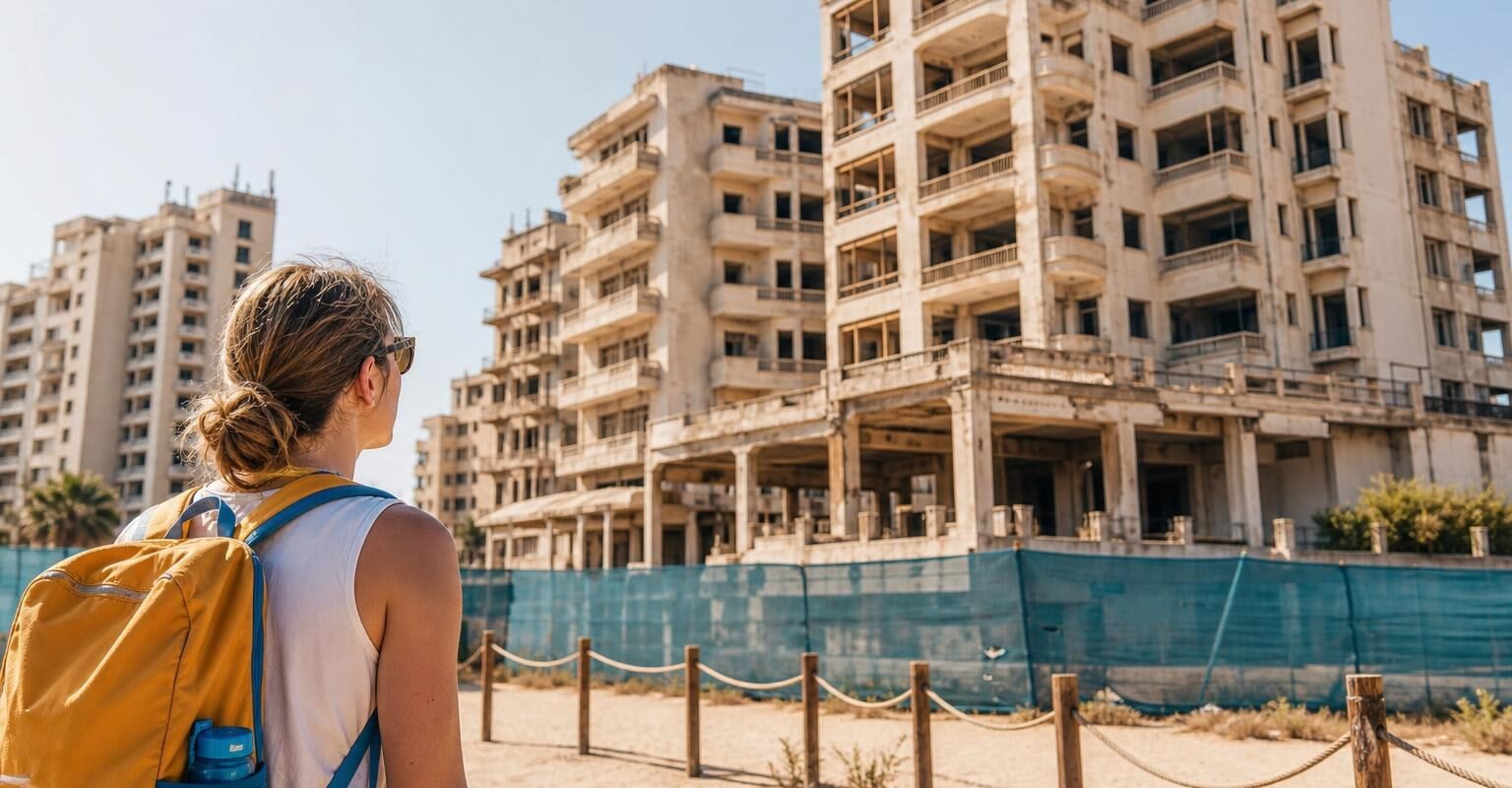
The open section of Varosha is compact but emotionally powerful. Walking along the beachfront, you’ll see the shells of high-rise hotels that once hosted international celebrities. Their balconies are collapsing, windows long shattered, and vegetation has reclaimed ground-floor lobbies.
The beach itself is striking. The sand is genuinely beautiful, and because the area was sealed off for decades, it’s one of the least developed stretches of coastline on the island. Sea turtles have been nesting here in the absence of human activity.
Along the accessible streets, you’ll notice personal traces of the lives interrupted in 1974: faded shop signs in Greek, rusted car frames, and the outlines of what were once busy commercial roads. Information boards placed by the TRNC authorities provide context, though their framing of events reflects a particular political perspective.
A few points to keep in mind:
- You cannot enter any buildings. They’re structurally unsafe and access is physically blocked.
- The open zone has a defined perimeter. Military personnel and barriers mark the boundaries clearly.
- There are public toilet blocks at the beach and kiosks near the entrance, but shade is limited. Bring water and sun protection, especially in summer when temperatures regularly exceed 35°C.
- Allow one to two hours for a thorough visit.
The Deryneia Viewpoint: Observing Without Crossing
If you’d rather not cross into the north, or if you’re short on time, the Deryneia viewpoint offers a distant but still affecting view of Varosha from the southern side.
Located in the town of Deryneia, just a few minutes’ drive from Ayia Napa, this viewing platform sits near the Green Line. Through binoculars or a telephoto lens, you can see the abandoned high-rises and empty streets stretching along the coast. A small cultural centre nearby provides historical context about the displacement of Famagusta’s Greek Cypriot population.
The viewpoint is free to visit and requires no passport or crossing formalities. It’s a worthwhile stop even if you do plan to cross, as it offers a wider perspective that you can’t get from ground level inside the open zone.
Note: The viewpoint area is in the buffer zone’s vicinity. Photography is permitted toward Varosha, but avoid pointing cameras at military installations or UN positions. Signs indicate restricted directions.
Ethical Considerations and Photography Rules
Visiting Varosha raises genuine ethical questions that are worth considering before you go. For many Greek Cypriots, the reopening of any part of Varosha by the TRNC authorities is an illegal act that undermines the property rights of displaced residents. Some argue that visiting legitimises the occupation. Others believe that witnessing the reality firsthand builds understanding and keeps the issue in public consciousness.
There’s no single right answer, but being informed matters. The Republic of Cyprus officially discourages visits to Varosha under TRNC auspices, though it doesn’t prevent its citizens or tourists from crossing.
Photography is permitted in the open zone, but with restrictions. You may not photograph military personnel, checkpoints, or restricted areas. Signs are posted, and guards will intervene if you point a camera in the wrong direction. Drone use is strictly prohibited.
Respect the space. This isn’t a theme park. Real people lost their homes, businesses, and communities here. Keep noise levels down, don’t attempt to take “souvenirs” from abandoned buildings, and treat the area with the gravity it deserves.
Frequently Asked Questions
Is Varosha safe to visit?
The open section is considered safe for visitors. The TRNC authorities maintain the accessible paths and beach area. Buildings are off-limits precisely because they’re structurally unsound. Stick to marked routes and you won’t encounter any safety issues.
How long does a visit to Varosha take?
Most visitors spend one to two hours in the open zone. Factor in an additional 30 to 60 minutes each way for the checkpoint crossing, plus driving time from your accommodation.
Do I need to book in advance?
No booking is required. The open area operates on a walk-in basis. Arrive early in the morning during summer to avoid both crowds and the worst of the heat.
Can I swim at Varosha beach?
Yes. The beach within the open zone is accessible for swimming. The water is clean and the sand is in good condition, partly because the area saw no development or heavy use for nearly 50 years.
Will my mobile phone work in the north?
Most UK and EU mobile phones will connect to northern Cyprus networks. Be aware that roaming charges may apply differently than in the south, as the TRNC uses Turkish mobile operators. Check with your provider before crossing.
Varosha sits at an extraordinary intersection of beauty and tragedy. A pristine Mediterranean beach backed by crumbling towers, each one a reminder of lives upended overnight. Whether you cross from the south to walk its streets or observe from the Deryneia viewpoint, the experience stays with you.
Plan your logistics carefully: sort your insurance, bring your passport, carry Turkish Lira, and leave early to beat the heat and the queues. If you’re renting a car through a provider like CyprusCarRental, clarify the crossing policy before you sign. A little preparation turns what could be a stressful day into a genuinely meaningful one. Whatever your perspective on the politics, seeing this place firsthand adds a dimension to understanding Cyprus that no guidebook can fully convey.