
Table of Contents
- The Natural Spectacle of Flamingos in Cyprus
- When to See Flamingos at Larnaca Salt Lake
- Best Viewpoints and the Larnaca Salt Lake Walk
- Getting There by Car
- Hala Sultan Tekke: A Spiritual Landmark on the Shore
- Extending Your Trip: The Kamares Aqueduct
- Photography Tips for Capturing Flamingos
- Responsible Wildlife Watching and Conservation
- Essential Visitor Information and Facilities
- Frequently Asked Questions About Larnaca Salt Lake
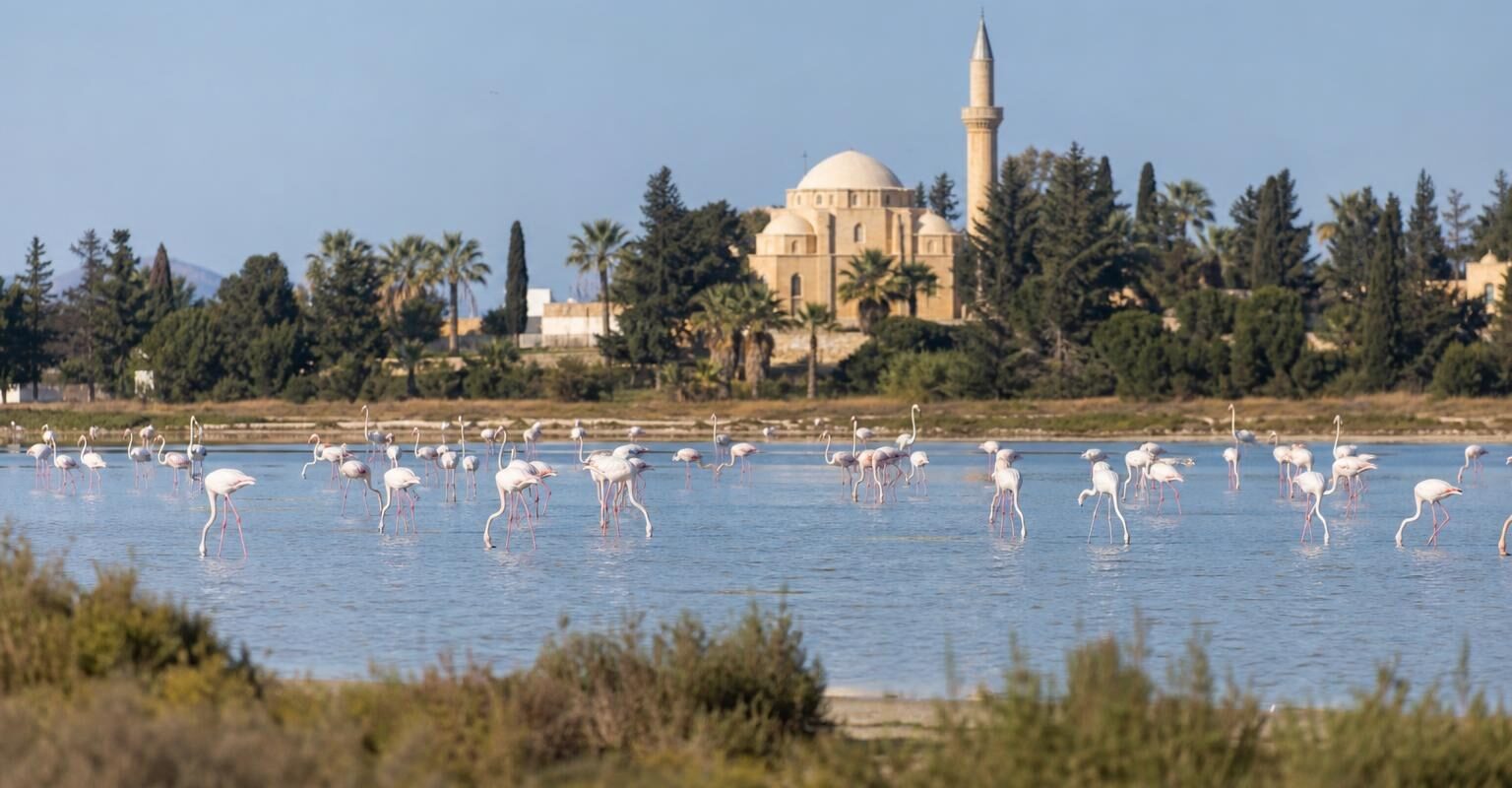
Every winter, thousands of greater flamingos descend on a shallow, shimmering lake just minutes from Larnaca’s seafront promenade. The sight of pink-tinged birds wading across still water, with the dome of an Ottoman-era mosque rising behind them, is one of Cyprus’s most striking natural scenes. If you’re planning a trip between late autumn and early spring, Larnaca Salt Lake should sit near the top of your itinerary: it’s free to visit, easy to reach by car, and pairs perfectly with a half-day of sightseeing around the city’s southern edge.
But timing matters. Water levels, rainfall patterns, and conservation pressures all influence when and how many flamingos you’ll actually see. This guide covers the best months, the walking trail, photography advice, and what to know about the historic Hala Sultan Tekke mosque on the lake’s western shore. You’ll also find practical details on parking, driving directions, and how to combine the visit with the nearby Kamares Aqueduct.
The Natural Spectacle of Flamingos in Cyprus
Larnaca Salt Lake is actually a network of four interconnected salt lakes covering roughly 2.2 square kilometres. During summer, the water evaporates almost entirely, leaving a crust of salt that once supported a commercial salt-harvesting industry. Come autumn rains, the lake refills and becomes a vital wetland habitat, drawing migratory birds from across the Eastern Mediterranean.
Greater flamingos are the headline act. The lakes around Larnaca and Akrotiri together host between 5,000 and 10,000 flamingos annually, representing over 1% of the total Eastern Mediterranean population. That makes Cyprus a genuinely significant stopover on the flamingo migration route, not just a curiosity.
The birds feed on brine shrimp and algae in the shallow, saline water. It’s these food sources that give them their characteristic pink colouring: the more carotenoid-rich their diet, the deeper the hue. On overcast mornings, you might mistake them for pale grey shapes, but catch them in low sunlight and the pink is unmistakable.
Note: Flamingo numbers in Cyprus have declined by 14 to 31% since 2013 due to drought, poor water quality, and human disturbance. What you see today is a population under pressure, which makes responsible viewing all the more important.
When to See Flamingos at Larnaca Salt Lake
Greater flamingos typically arrive in November and depart by March, with peak sightings between December and February. A few early arrivals sometimes appear in October, and stragglers can linger into April, but you shouldn’t count on it.
The best strategy is to visit during January or February, when the lake is most likely to hold adequate water and the largest flocks are present. Early morning offers the calmest conditions and softest light: the birds tend to feed actively at dawn before the wind picks up.
The Impact of Water Levels and Seasonal Rainfall
Flamingo presence depends almost entirely on water. If autumn rains are late or light, the lake may not fill enough to support the brine shrimp populations the birds rely on. The 2025 migration illustrated this clearly: a prolonged dry spell meant significant flocks only reached the lake in late November following the first major winter rains.
Larnaca has faced increasing water stress in recent years. As of February 2026, the Larnaca District Local Government implemented regional water pressure reductions due to extreme scarcity: a sign that drought conditions affect the whole region, not just the lake.
If you’re travelling specifically to see flamingos, check local birdwatching groups or the BirdLife Cyprus social media channels a week or two before your trip. They regularly post updates on flock sizes and water conditions, which can save you from arriving to an empty lakebed.
Pro Tip: Flamingos tend to concentrate on the western and southern edges of the lake, closest to Hala Sultan Tekke. If the lake is only partially filled, that’s where the remaining water usually pools.
Best Viewpoints and the Larnaca Salt Lake Walk
A paved and gravel nature trail runs along the lake’s perimeter, offering several excellent vantage points without requiring you to leave the path. The most popular stretch runs from the Hala Sultan Tekke car park along the western shore, where the trail passes within a few hundred metres of the water’s edge.
Other good viewpoints include the elevated section near the airport road (accessible from the eastern side) and the benches positioned along the southern trail. These spots give you a wide panorama across the lake, which is useful for spotting distant flocks.
Navigating the Nature Trail for Birdwatching
The Larnaca Salt Lake walk is flat and accessible, suitable for pushchairs and wheelchairs along most of its length. The full loop is roughly 5 kilometres, but most visitors cover just a portion: the 2-kilometre stretch from the Tekke car park to the southern viewpoint and back is the most rewarding section.
- Wear comfortable shoes with grip: the gravel sections can be loose after rain.
- Bring binoculars. The flamingos often feed 200 to 400 metres from the shore, and the naked eye won’t pick up much detail at that distance.
- Stay on the marked trail. Straying towards the waterline disturbs the birds and damages the fragile lakeshore habitat.
- There’s no shade along most of the path, so bring a hat and water even in winter: Larnaca’s January afternoons can reach 17 to 18°C.
The trail also passes information boards about the lake’s ecology and the bird species you might spot beyond flamingos, including herons, stilts, and various waders.
Getting There by Car
The salt lake sits immediately southwest of Larnaca town centre, partially bordered by the airport road. It’s one of the easiest natural attractions on the island to reach.
| Detail | Info |
|---|---|
| From Larnaca centre | 4 km, roughly 10 minutes |
| From Larnaca airport | 2 km, 5 minutes |
| From Limassol | 68 km via the A1 motorway, about 45 minutes |
| From Nicosia | 52 km via the A2 motorway, about 40 minutes |
| Road condition | Fully paved, well-signposted |
| Parking | Free car park at Hala Sultan Tekke (approximately 50 spaces) |
Follow signs for Hala Sultan Tekke from the airport roundabout. The car park is clearly marked and rarely full outside of peak Sunday mornings in January. A second, smaller parking area exists on the eastern side of the lake, accessible from Artemidos Avenue.
Important: Most rental car agreements in Cyprus exclude off-road driving. The salt lake trails are pedestrian-only, and you shouldn’t attempt to drive onto the dry lakebed in summer: it’s both prohibited and risks getting stuck. Stick to the paved roads and designated car parks. If you’re renting a car for the day, the salt lake combines well with a loop taking in the Kamares Aqueduct and Larnaca’s seafront.
Hala Sultan Tekke: A Spiritual Landmark on the Shore
Standing on the western bank of the lake, Hala Sultan Tekke is one of the most recognisable buildings in Cyprus. The mosque and its surrounding gardens create a peaceful counterpoint to the natural spectacle on the water.
History and Significance of the Mosque
The mosque is traditionally associated with Umm Haram, an aunt of the Prophet Muhammad, who is said to have died here during the Arab raids on Cyprus in 649 AD. The current structure dates primarily to the late 18th and early 19th centuries, though the site’s religious importance stretches back much further.
The surrounding archaeological zone has yielded remarkable finds. Recent excavations at the nearby Dromolaxia-Vyzakia site uncovered 3,400-year-old gold diadems alongside lapis lazuli and amber artefacts, confirming this area was a major international trade hub during the Bronze Age. The mosque itself remains an active place of worship and is considered one of the holiest sites in Islam after Mecca and Medina by some traditions.
Visiting Etiquette and Opening Hours
The mosque is open to visitors, but respectful behaviour is expected. Remove your shoes before entering the prayer hall. Women should cover their shoulders and knees: lightweight scarves are sometimes available at the entrance, but it’s best to bring your own.
Opening hours can vary, particularly during Ramadan and religious holidays. As of 2026, the site is generally open daily from morning until late afternoon, but hours shift seasonally. Check with the Larnaca tourism office or look for posted times at the gate. Entry is free.
The gardens around the mosque are lovely for a quiet walk, with palm trees and well-kept paths leading down towards the lake. It’s a natural starting point for the salt lake trail.
Extending Your Trip: The Kamares Aqueduct
About 2 kilometres north of the salt lake, the Kamares Aqueduct is a handsome stone structure built in 1747 under Ottoman rule to carry water into Larnaca. Its 33 surviving arches stretch across a shallow valley and are particularly photogenic in the late afternoon light.
The aqueduct is visible from the main road, but it’s worth pulling over for a closer look. A small layby provides parking, and you can walk along the base of the arches. There’s no entrance fee and no formal opening hours: it’s an open-air monument.
Combining the aqueduct with a visit to the salt lake and Hala Sultan Tekke makes for a satisfying half-day itinerary. Drive from the Tekke car park north along Artemidos Avenue, and you’ll reach the aqueduct in under five minutes. From there, Larnaca’s seafront promenade (Finikoudes) is another five minutes by car.
Photography Tips for Capturing Flamingos
Flamingos look spectacular in photographs, but getting a good shot from the shore requires some planning. The birds rarely come closer than 200 metres, so a long telephoto lens (300mm or longer on a full-frame camera) is essential for frame-filling shots. Smartphone cameras, even recent models, will struggle at this distance.
- Shoot during the golden hour: the first hour after sunrise or the last hour before sunset. Low-angle light turns the water golden and intensifies the pink of the feathers.
- Use a tripod or monopod. At long focal lengths, even slight hand movement causes blur.
- Overcast days can work well for even lighting, but you’ll lose the warm tones that make flamingo photos stand out.
- Include the landscape. Some of the most memorable images show the flamingos as small figures against the vast, flat lake with Hala Sultan Tekke in the background. These wider compositions tell a story that a tight crop on a single bird can’t.
- Patience pays off. Flamingos periodically stretch their wings, take off in small groups, or engage in synchronised head-turning displays. Wait for these moments rather than firing off dozens of identical standing shots.
Tip: The western shore near Hala Sultan Tekke gives you the best angle for including the mosque in your flamingo shots. Arrive before 9 a.m. for the softest light and fewest other visitors.
Responsible Wildlife Watching and Conservation
The flamingos at Larnaca are wild migratory birds, not a managed attraction. Their continued presence depends on the health of the wetland and how visitors behave around it.
Keep your distance. The marked trail exists for a reason: approaching the waterline causes the birds to flush, wasting energy they need for feeding and migration. Drones are prohibited over the lake, and flying one risks a fine as well as serious disturbance to the flock.
Keep noise to a minimum, especially in early morning when the birds are most active. Dogs should be kept on leads along the entire trail.
The decline of up to 31% in Cyprus’s flamingo population since 2013 is a reminder that this spectacle isn’t guaranteed to continue indefinitely. Drought, urban development around the lake’s catchment area, and water pollution all pose ongoing threats. Visitors can help by sticking to the trail, taking litter away, and supporting local conservation organisations like BirdLife Cyprus.
Essential Visitor Information and Facilities
The salt lake area has limited facilities, so come prepared.
- There are no cafés or shops at the Hala Sultan Tekke car park. The nearest options are along Larnaca’s seafront, about 10 minutes’ drive away.
- Public toilets are available near the mosque entrance, though they may not always be open.
- The trail has no drinking water fountains. Bring at least a litre per person, especially if you’re walking the full loop.
- Sun protection matters year-round: even in December, the reflected light off the lake can cause sunburn.
- Mobile phone signal is strong throughout the area.
- The site is free to visit, with no tickets or booking required.
| Season | What to expect |
|---|---|
| Nov – Mar | Flamingos present (peak Dec – Feb), lake filled, mild temperatures (10 – 18°C) |
| Apr – May | Flamingos departing, wildflowers along the trail, pleasant walking weather |
| Jun – Oct | Lake mostly dry, no flamingos, extreme heat (35°C+), limited interest |
Frequently Asked Questions About Larnaca Salt Lake
How many flamingos are at Larnaca Salt Lake?
Numbers vary each year depending on rainfall and water levels. In good seasons, several thousand greater flamingos use the lake, though the total across Larnaca and Akrotiri salt lakes ranges from roughly 5,000 to 10,000 birds. Recent years have seen lower numbers due to drought.
Can I visit the salt lake in summer?
You can, but there’s little to see. The lake dries out almost completely between June and October, leaving a white salt crust. No flamingos are present, and temperatures regularly exceed 35°C, making the exposed trail uncomfortable.
Is there an entrance fee?
No. Both the salt lake trail and Hala Sultan Tekke are free to visit. Parking at the main car park is also free.
Do I need binoculars to see the flamingos?
You can spot the flamingos with the naked eye as pink shapes on the water, but binoculars or a spotting scope make a significant difference. The birds typically feed 200 to 400 metres from the shore, so magnification lets you appreciate their behaviour and colouring properly.
Is the trail suitable for children and pushchairs?
Yes. The main trail is flat and mostly paved or compacted gravel. The 2-kilometre section from the Tekke car park to the southern viewpoint is the easiest stretch and suitable for pushchairs and young children.
The flamingos of Larnaca Salt Lake are one of Cyprus’s most rewarding winter sights: free, accessible, and genuinely impressive. Pair the visit with Hala Sultan Tekke and the Kamares Aqueduct for a morning that blends natural history, archaeology, and a good stretch of the legs. Just remember to check water conditions before you go, bring binoculars, and give the birds the space they need. With a rental car and an early start, you can cover all three sites comfortably before lunch.