
Table of Contents
- Planning a Morning of Antiquity in Paphos
- Getting to the Sites by Car
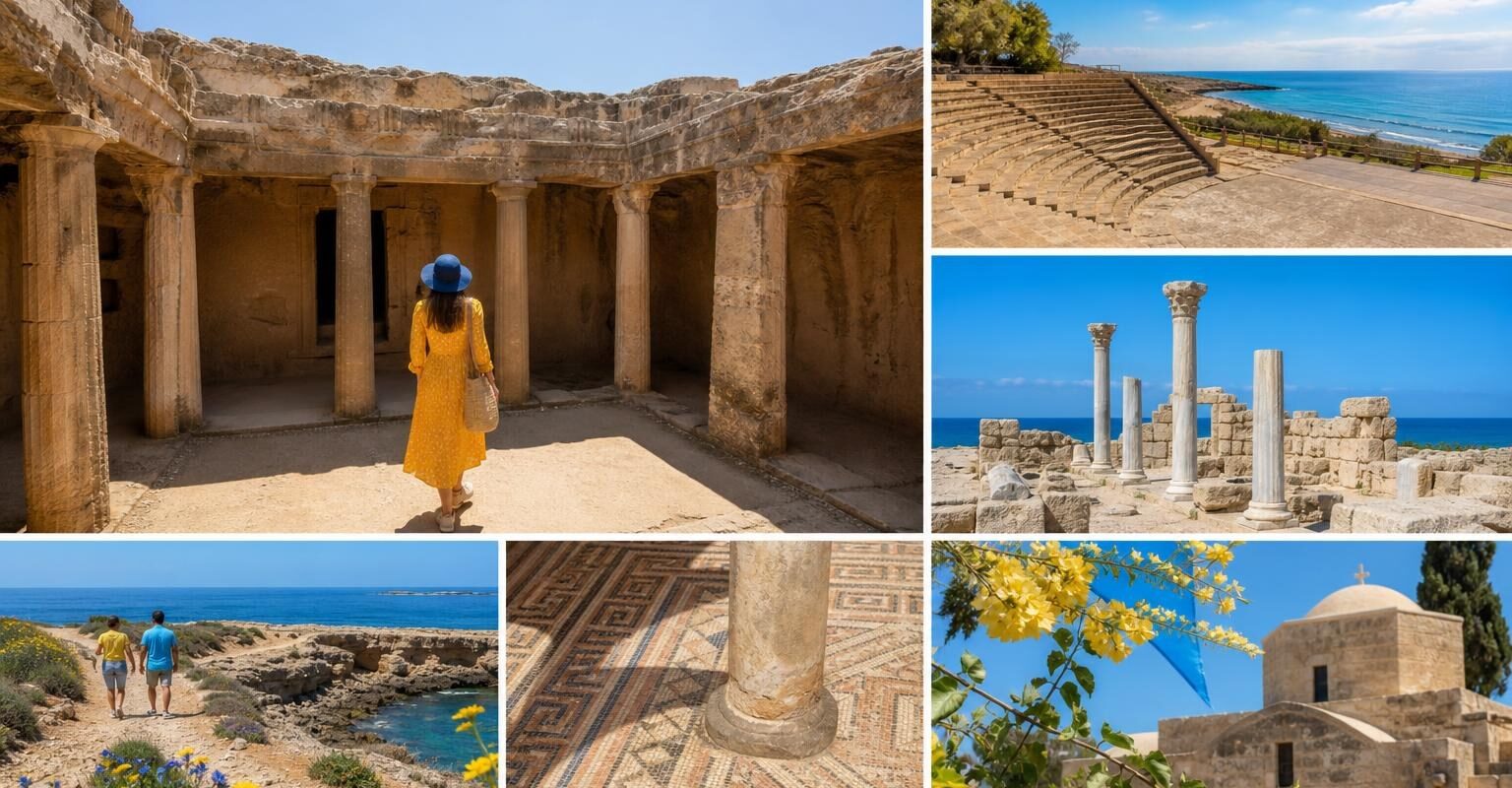
- First Stop: The Tombs of the Kings Paphos
- Kato Paphos Archaeological Park: The Mosaics and Beyond
- A Step-by-Step Morning Itinerary
- Key Takeaway: Maximising Your UNESCO Experience
- Practical Tips for a Smooth Visit
- Frequently Asked Questions
Yes, you can comfortably visit both the Tombs of the Kings and the Paphos Archaeological Park in a single morning, provided you start early and have a rough plan. These two UNESCO-listed sites sit roughly two kilometres apart along the coast of Kato Paphos, making them ideal for a back-to-back visit by car. With Paphos drawing a 30% increase in visitors over recent years, arriving before the tour buses is the smartest move you can make. Here’s exactly how to structure your morning so you see the best of both sites without rushing or overheating.
Planning a Morning of Antiquity in Paphos
A half-day itinerary covering both sites is realistic because neither one demands more than 90 minutes for a thorough visit. The Tombs of the Kings is a compact, open-air necropolis you can walk in about 45 to 60 minutes. The archaeological park at Kato Paphos is larger but manageable if you prioritise the mosaic houses and a handful of key monuments.
The trick is sequencing. Start at the Tombs of the Kings when the gates open at 08:30, then drive south to the archaeological park by around 09:30 or 10:00. This order keeps you at the more exposed, shade-free necropolis during the coolest part of the morning and gets you to the partially shaded mosaic houses before midday heat peaks.
From April 16 to September 15, summer operating hours run from 08:30 to 19:30, with the last ticket sold at 19:00. In winter (September 16 to April 15), closing time shifts earlier to 17:00. For a morning visit, summer hours are generous, but the temperature is the real constraint: by 11:30 in July or August, exposed stone surfaces radiate serious heat.
Budget roughly three hours total for both sites, plus 15 minutes of driving and parking transitions. You’ll be done before lunch, leaving the afternoon free for the harbour, a swim, or a drive into the hill villages.
Getting to the Sites by Car
Both sites are on or just off Tombs of the Kings Road (Leoforos Tafon ton Vasileon), the main coastal road running north from Kato Paphos harbour. If you’re staying anywhere in the Paphos hotel strip, the drive is five minutes or less. From Paphos town centre, it’s about three kilometres.
The Tombs of the Kings has its own signposted car park directly at the entrance. It’s free, paved, and rarely full if you arrive by 08:30. The archaeological park at Kato Paphos has a larger car park off Apostolou Pavlou Avenue, close to the harbour. Parking here is free but fills quickly by mid-morning in summer, so arriving before 10:00 helps.
If you’ve picked up a rental car at Paphos Airport, the drive to the Tombs of the Kings is roughly 15 kilometres along the B6 motorway, taking about 20 minutes. Roads are fully paved and well-signposted in English and Greek. Keep in mind that Cyprus drives on the left, which feels familiar for UK visitors but can catch others off guard.
Pro Tip: Most rental agreements in Cyprus exclude off-road driving. Both archaeological sites are accessed via normal paved roads, so this won’t affect your visit. However, if you’re planning to explore the Akamas Peninsula later in the day, check your agreement before heading onto dirt tracks.
First Stop: The Tombs of the Kings Paphos
Despite the grand name, no actual kings were buried here. The necropolis served high-ranking officials and wealthy citizens of ancient Nea Paphos from the 3rd century BC through the 3rd century AD. The “royal” label comes from the sheer scale of the tombs: some are carved deep into the bedrock with colonnaded courtyards that wouldn’t look out of place in a Ptolemaic palace.
The site covers a wide, rocky plateau overlooking the sea. Seven main tomb complexes are numbered and signposted along a circular walking route. You don’t need to visit every single one to appreciate the site. Tombs 3, 4, and 8 are the highlights.
Recent archaeological work has added new layers of understanding. Excavations at Tomb 8 uncovered evidence of rare cremation rituals and limestone falcon sculptures that experts believe may link the burials to the Ptolemaic royal family or senior administrators. These findings reinforce the Egyptian-Macedonian character of the necropolis and make the “Kings” label feel a little less exaggerated.
Exploring the Doric Architecture of Tomb 3 and 4
Tomb 3 is the one you’ll recognise from postcards. You descend a carved staircase into an open atrium surrounded by Doric columns on all four sides. Burial chambers open off this central courtyard, cut directly into the rock face. The effect is striking: a miniature underground peristyle house designed for the dead.
Tomb 4 follows a similar layout but is even more photogenic, with better-preserved columns and a deeper courtyard. Stand in the centre and look up: the rectangular patch of blue sky framed by pale limestone columns is one of those moments that justifies the early start.
Both tombs show clear Alexandrian influence, imported by the Ptolemaic rulers who controlled Cyprus from the late 4th century BC. The architectural style mirrors tombs found in Alexandria, Egypt, a reminder that ancient Paphos was deeply connected to the eastern Mediterranean’s power centres.
Allow 45 to 60 minutes for the full loop. If you’re pressed for time, walk directly to Tombs 3 and 4, then glance at Tomb 8 on your way out.
Attention Block: Managing the Heat and Terrain
Weather Alert: The necropolis has almost no shade. In summer, ground temperatures on exposed rock can exceed 45°C by mid-morning. Wear a hat, apply sunscreen before you arrive, and carry at least 500ml of water per person. There’s a small kiosk near the entrance, but prices are tourist-level.
The terrain is uneven throughout: rough limestone, loose gravel, and steep carved staircases without handrails. Sturdy shoes with grip are essential. Flip-flops are a genuinely bad idea here. Some tomb entrances involve ducking through low-cut rock passages, so watch your head.
Pushchairs and wheelchairs can manage the main path between tombs but won’t make it down into the underground courtyards. If mobility is a concern, you can still appreciate Tombs 3 and 4 from the upper viewing points.
Kato Paphos Archaeological Park: The Mosaics and Beyond
The archaeological park at Kato Paphos is a different experience entirely. Where the Tombs of the Kings is raw, rocky, and elemental, this site is layered with colour and narrative. It covers the remains of ancient Nea Paphos, which served as the capital of Cyprus during the Roman period. The star attractions are the mosaic floors of four Roman villas, but the park also holds a restored Odeon, a medieval fortress, a lighthouse, and ongoing excavation areas.
The park is large: roughly 30 hectares. You won’t cover everything in 90 minutes, and you don’t need to. Focus on the mosaic houses and one or two secondary monuments, and you’ll leave satisfied.
A €1 million infrastructure project announced for 2026 includes the installation of elevated pedestrian bridges and transparent flooring over some mosaic areas. These improvements aim to protect the remains while giving visitors better viewing angles. You may encounter some sections under temporary closure for conservation work, so be prepared for minor route adjustments.
Masterpieces in Stone: The Paphos Mosaics
The mosaic floors are the reason most people visit, and they genuinely deliver. Four Roman-era houses contain some of the finest surviving mosaics in the eastern Mediterranean, dating from the 2nd to the 5th century AD.
The House of Dionysos is the largest and most famous. Its floors depict scenes from Greek mythology: Dionysos riding a leopard, Narcissus gazing at his reflection, the triumph of Dionysos over Ikarios. The colours remain remarkably vivid, and the detail in the figures’ expressions and clothing is extraordinary for floor art that’s nearly two thousand years old.
The House of Theseus contains a circular mosaic showing Theseus battling the Minotaur. The House of Aion, discovered only in 1983, features five panels depicting mythological scenes with a sophistication that rivals wall paintings. The House of Orpheus rounds out the collection with a large mosaic of Orpheus charming animals with his lyre.
Walk through them in this order: Dionysos, Theseus, Aion, Orpheus. Each house has raised wooden walkways that let you view the floors from above without stepping on them.
The Odeon and Saranta Kolones Fortress
If you have time after the mosaics, two other structures deserve a quick visit. The Odeon is a small restored Roman theatre built in the 2nd century AD. It seats around 1,200 and is still used for summer performances. It sits on a hillside with views across the park toward the sea, making it a pleasant spot to catch your breath.
Saranta Kolones (Forty Columns) is the ruin of a Lusignan-era fortress, built in the 13th century and destroyed by an earthquake in 1222. The name refers to the granite columns, likely salvaged from Roman buildings, that were used in its construction. Scattered column drums still litter the site. It’s atmospheric but doesn’t require more than 10 minutes unless you’re particularly interested in Crusader-period architecture.
Skip the lighthouse area and the far eastern sections of the park if you’re watching the clock. They’re pleasant walks but don’t hold major monuments.
A Step-by-Step Morning Itinerary
Here’s a practical schedule that works for summer visits (April through September):
| Time | Activity | Duration |
|---|---|---|
| 08:15 | Arrive at Tombs of the Kings car park | – |
| 08:30 | Enter the necropolis, walk to Tombs 3, 4, and 8 | 50 min |
| 09:20 | Drive south to Kato Paphos Archaeological Park | 10 min |
| 09:30 | Enter the park, visit Houses of Dionysos, Theseus, Aion, Orpheus | 60 min |
| 10:30 | Walk to the Odeon and Saranta Kolones | 20 min |
| 10:50 | Exit the park | – |
| 11:00 | Coffee or early lunch at Kato Paphos harbour | – |
This schedule gives you a comfortable three-hour window with time to read information boards and take photos. In winter, you can shift the start time later since heat isn’t a factor, but daylight hours are shorter.
Ticket Prices and Entry Logistics
As of 2026, individual entry fees are €4.50 for the archaeological park and €2.50 for the Tombs of the Kings. A One-Day Special Entry Card covering multiple sites across the Paphos district costs €8.50, which saves you a small amount if you’re visiting both sites plus a third attraction like the Paphos Castle.
Tickets are sold at each site’s entrance. Card payments are accepted. There are no advance booking requirements or timed entry slots: you simply turn up and walk in.
Both sites have basic facilities at the entrance: toilets, a small shop, and water. The archaeological park’s facilities are slightly better, with a covered seating area near the ticket office.
What to Skip if You Are Short on Time
If you only have two hours total, here’s what to prioritise and what to cut:
- Keep: Tombs 3 and 4 at the necropolis (20 minutes)
- Keep: House of Dionysos and House of Aion at the park (40 minutes)
- Cut: Tombs 1, 2, 5, 6, and 7 at the necropolis
- Cut: House of Orpheus (the weakest of the four mosaic houses)
- Cut: Saranta Kolones fortress (interesting but not essential)
- Cut: The eastern sections of the park beyond the Odeon
This stripped-back version still gives you the two most impressive tombs and the two finest mosaic collections. You’ll see the best of both sites in under two hours.
Key Takeaway: Maximising Your UNESCO Experience
The single most important factor for enjoying these sites is timing. Arriving at 08:30 gives you cool temperatures, empty pathways, and soft morning light that’s ideal for photography. By 11:00, the tour bus groups have arrived in force, the car parks are full, and the heat at the Tombs of the Kings becomes punishing.
Visiting by car makes the logistics simple. The two sites are close together, parking is free at both, and you control your own schedule. If you’re renting a car for your Paphos trip, building this morning loop into your first or second day sets a strong tone for the rest of your stay.
Don’t underestimate hydration. Carry more water than you think you’ll need. The combination of walking on reflective limestone, climbing stairs, and standing in direct sun drains energy faster than a typical beach day.
Practical Tips for a Smooth Visit
- Wear closed-toe shoes with decent grip. Both sites have uneven stone surfaces, and the tomb staircases can be slippery.
- Bring a portable phone charger. You’ll take more photos than you expect, and there’s no charging anywhere on site.
- Download an offline map of both sites before you go. Mobile signal is generally fine, but having a map that works without data is useful for navigating the larger archaeological park.
- A small pair of binoculars helps at the mosaic houses. Some floor panels are viewed from elevated walkways, and the finer details reward closer inspection.
- If you’re visiting with children, the Tombs of the Kings tends to hold their attention better than the mosaics. The underground chambers feel like genuine exploration.
Important: Recent excavations at Fabrika Hill, near the Tombs of the Kings, revealed a large Hellenistic defensive tower and a complex rock-cut water management system. Some areas around the necropolis may have restricted access due to ongoing archaeological work. Check for signage at the entrance and respect any cordoned-off zones.
Frequently Asked Questions
Can I visit both the Tombs of the Kings and the Paphos Archaeological Park in one morning?
Yes. The two sites are about two kilometres apart and can be comfortably covered in three hours if you arrive at 08:30. Start at the Tombs of the Kings, spend 45 to 60 minutes there, then drive to the archaeological park for 60 to 90 minutes.
How much does it cost to visit both sites?
As of 2026, entry is €2.50 for the Tombs of the Kings and €4.50 for the archaeological park. A combined One-Day Special Entry Card costs €8.50 and covers additional sites in the Paphos area.
Is there shade at either site?
The Tombs of the Kings has almost no shade. The archaeological park is slightly better: the mosaic houses have protective roof structures, and some paths are tree-lined. Regardless, bring a hat and sunscreen for both.
Are the sites accessible for wheelchair users?
The main paths at both sites are partially accessible, but the underground tomb chambers and some mosaic house walkways involve steps. Wheelchair users can view several tombs from ground level and access some mosaic areas via ramps, but full access is limited.
What’s the best time of year to visit?
Spring (March to May) and autumn (October to November) offer the best balance of comfortable temperatures and manageable crowds. Summer visits are fine if you start early, but midday heat makes the experience less enjoyable. Winter is quiet and cool but has shorter opening hours.