
Table of Contents
- The Legacy of Commandaria: The World’s Oldest Named Wine
- Planning Your Commandaria Wine Route Journey
- The Eastern Villages: Kalo Chorio and Zoopigi
- Cruising the Central Foothills: Agios Mamas and Kapileio
- The Western Gateway: Doros and Laneia
- Cellar Door Experiences and Tasting Etiquette
- Practical Logistics for a Cyprus Wine Road Trip
- Frequently Asked Questions About Commandaria
Cyprus holds the distinction of producing the world’s oldest named wine still in production: a sweet, amber dessert wine crafted from sun-dried grapes in a cluster of small villages across the southern Troodos foothills. Commandaria has been made in this same corner of the island for over 5,000 years, and the method has barely changed. Grapes are picked, spread on mats under the fierce Mediterranean sun, and left to concentrate their sugars before fermentation and long barrel ageing.
Driving this route yourself is the most rewarding way to experience it. The 14 designated villages sit within roughly 30 kilometres of Limassol, connected by quiet roads that wind through vineyards, limestone slopes, and orchards. You can cover the highlights in a single day or spread the trip across a weekend, stopping for tastings, a winery museum, and long lunches in stone-walled tavernas. What follows is a practical, village-by-village guide to planning that drive.
Warning: Do not drink and drive. Cyprus enforces a strict blood alcohol limit of 0.05% (0.22 mg/L breath) for experienced drivers. If you plan to taste wine at multiple stops, appoint a designated driver, arrange a taxi back to your accommodation, or book an overnight stay in one of the villages.
The Legacy of Commandaria: The World’s Oldest Named Wine
The name itself dates to the 13th century, but the wine predates the label by millennia. Ancient texts reference a sweet Cypriot wine that matches the modern product almost exactly: sun-dried grapes, long fermentation, and a rich, honeyed character. What sets this wine apart from other historical curiosities is that it never stopped being made. The villages, the grape varieties, and the production techniques form an unbroken chain.
Production is strictly limited by law to 14 specific villages in the Troodos foothills. No wine made outside these boundaries can carry the name. This geographic restriction, formalised through a Protected Designation of Origin (PDO), makes it one of the most tightly controlled appellations in the wine world.
From Sun-Dried Grapes to Protected Designation
Two indigenous grape varieties form the foundation: Xynisteri (white) and Mavro (red). After harvest in September, the grapes are spread on mats and sun-dried for 7 to 10 days until they reach a specific sugar concentration. This process, called anama, intensifies the flavours and raises the potential alcohol level.
Once pressed, the juice ferments slowly, and the resulting wine must age for a minimum of two years in oak barrels before release. Many producers age theirs far longer: 10, 15, even 20 years. The finished product ranges from deep amber to near-mahogany, with flavours of dried fig, caramel, raisin, and warm spice. Alcohol content typically sits between 15% and 20%.
Knights Templar and the Royal Connection
The Crusader order known as the Knights Templar gave the wine its current name after establishing their headquarters, the Grande Commanderie, in the Limassol district during the 12th century. They exported it across Europe, where it became a favourite at royal courts. Richard the Lionheart reportedly called it “the wine of kings and the king of wines” at his wedding feast in Limassol in 1191.
The wine’s cultural significance received formal international recognition in December 2025, when it was inscribed on the UNESCO Representative List of the Intangible Cultural Heritage of Humanity. The UNESCO designation recognises not just the wine itself but the communal rituals surrounding its production: the harvest, the sun-drying, and the shared knowledge passed between generations.
Planning Your Commandaria Wine Route Journey
The Cyprus wine route through the commandaria villages runs roughly east to west along the southern slopes of the Troodos range, starting about 25 kilometres north of Limassol. You can pick up a rental car in Limassol or at Larnaca or Paphos airports and reach the first village within 30 to 40 minutes.
A realistic itinerary covers six to eight villages in a day. The roads are paved throughout, though some stretches are narrow and winding. A standard rental car handles everything on this route comfortably: no 4×4 is needed. Keep in mind that most rental agreements exclude off-road driving, and insurance from Republic of Cyprus providers does not cover travel to the north of the island.
| Route Section | Key Villages | Distance from Limassol | Drive Time | Main Attractions |
|---|---|---|---|---|
| Eastern | Kalo Chorio, Zoopigi | 25-30 km | 30-35 min | Commandaria Museum, traditional wineries |
| Central | Agios Mamas, Kapileio | 30-35 km | 35-40 min | Small-batch producers, vineyard walks |
| Western | Doros, Laneia | 35-40 km | 40-45 min | Restored wine presses, art galleries |
Tip: Start early. Most village wineries and the Commandaria Museum keep limited hours, often closing by mid-afternoon. Confirm opening times locally before setting out, as schedules can shift seasonally. Aim to begin your drive by 9:00 or 9:30 AM.
Fuel up in Limassol before heading into the hills. Petrol stations thin out quickly once you leave the main road, and mobile signal can be patchy in the deeper valleys. A downloaded offline map on your phone is more reliable than depending on live GPS data.
The Eastern Villages: Kalo Chorio and Zoopigi
The eastern end of the route makes a logical starting point if you’re driving from Limassol. Head north on the B8 toward the village of Kalo Chorio, a compact settlement of stone houses and terraced vineyards sitting at around 400 metres elevation. The village has been producing wine for centuries, and several families still maintain small plots of Xynisteri and Mavro vines.
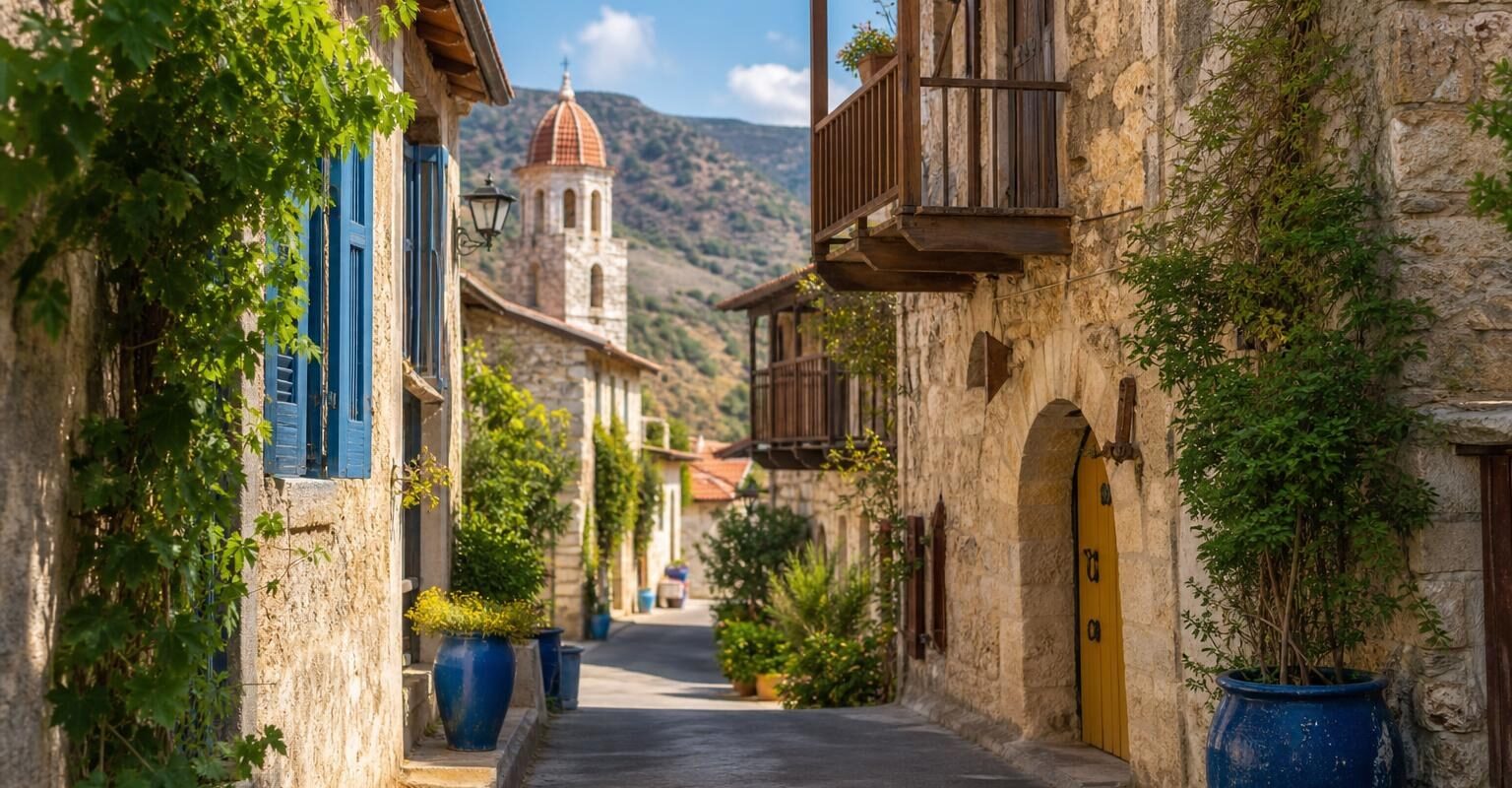
Kalo Chorio itself is quiet and unhurried. Park near the village square and walk the narrow lanes to get a sense of the traditional architecture: thick limestone walls, wooden balconies, and courtyards where grapes were once dried on rooftops. A couple of small producers here welcome visitors, though it’s best to call ahead rather than turn up unannounced.
From Kalo Chorio, it’s a short 5-kilometre drive west to Zoopigi, following signs along the village road. The route passes through low scrubland and vineyard terraces with views south toward the coast.
Zoopigi: The Commandaria Museum and Traditional Production
Zoopigi is the most visitor-oriented village on the eastern stretch. The Commandaria Museum here documents the wine’s history through artefacts, old presses, and displays explaining the sun-drying and ageing process. It’s small but well-curated, and a good place to ground yourself in the basics before tasting at other stops along the route.
The village also hosts one of the region’s better-known small wineries, where you can sample different vintages and see the oak barrels where the wine matures. Tasting portions are small: this is a dessert wine with high sugar content, so a little goes a long way.
Note: Commandaria is traditionally served slightly chilled, around 10-14°C, and pairs well with halloumi, dried fruits, nuts, and dark chocolate. Ask your host for pairing suggestions: they’ll usually bring out a plate of local snacks alongside the tasting.
Cruising the Central Foothills: Agios Mamas and Kapileio
Heading west from Zoopigi, the road climbs gently through the central section of the commandaria villages. Agios Mamas sits at roughly 500 metres, surrounded by older vineyards and almond groves. This is a quieter stop than Zoopigi, with fewer formal tasting facilities but a stronger sense of the agricultural rhythm that defines daily life here.
Several families in Agios Mamas still produce wine using methods that haven’t fundamentally changed in generations. The communal harvest and sun-drying process is a carrier of identity and collective memory that binds communities to the land, and you can see evidence of this in the shared drying platforms and cooperative spirit of the village.
Kapileio, a few kilometres further along, is one of the smallest settlements on the route. It doesn’t have a formal winery or museum, but it rewards a brief stop for its views and its stone church. The drive between these two villages follows a particularly scenic stretch of road, with the Troodos peaks visible to the north and the coastal plain stretching south.
Getting there by car: From Zoopigi to Agios Mamas is approximately 8 km, taking around 12 minutes on paved but narrow roads. Parking is informal: pull over near the village square or church. From Agios Mamas to Kapileio is another 4 km, roughly 7 minutes. Roads are in good condition year-round, though watch for loose gravel on shoulders.
The Western Gateway: Doros and Laneia
The western section of the route holds two of the most photogenic villages. Doros sits on a hillside above a small river valley, its old quarter a tangle of restored stone houses and narrow paths. The village has a couple of tavernas serving traditional Cypriot meze, and September visits coincide with the grape harvest, when the air smells of fermenting fruit and the drying mats are spread across every available flat surface.
From Doros, the road drops briefly before climbing to Laneia (also spelled Lania), roughly 4 kilometres to the west. This is perhaps the most visited village on the entire route, and for good reason: it combines wine heritage with a lively arts scene.
Laneia: The Artistic Village of Wine Presses
Laneia has attracted painters, potters, and sculptors over the past few decades, and their studios sit alongside restored wine presses and traditional houses. The old communal wine press in the village centre has been preserved as a small exhibition space, and several galleries display work inspired by the surrounding landscape.
The village also has a well-regarded taverna or two where you can stop for lunch. Expect slow-cooked lamb, fresh village salad, and locally made halloumi. If you’re spending the night, a handful of agrotourism guesthouses offer simple, comfortable rooms in converted stone buildings.
Getting there by car: From Limassol, Laneia is approximately 38 km via the E110 and then local roads, taking around 40-45 minutes. Parking is available at the village entrance. If you’re following the full route from east to west, Laneia makes a natural final stop before heading back downhill to the coast.
Cellar Door Experiences and Tasting Etiquette
Visiting a commandaria producer is different from touring a large commercial winery. Most operations here are family-run, and tastings tend to be informal, personal affairs. You might sit in a courtyard or a barrel room rather than a polished tasting lounge.
A few practical points to keep in mind:
- Call ahead whenever possible. Many producers don’t keep fixed public hours, and some require advance notice to prepare tastings.
- Tastings are often free or cost a nominal fee. If you enjoy what you try, buying a bottle or two is both good manners and a direct way to support the village economy.
- Sip slowly. This is a wine with significant residual sugar and higher alcohol than a typical table wine. Three or four small tastes across a morning is plenty.
- Ask questions. Producers are proud of their craft and happy to explain the drying process, barrel selection, and blending decisions.
Don’t expect the polished experience of a Napa Valley estate or a Bordeaux château. The charm here is in the authenticity: cracked terracotta tiles, dusty barrels, and a winemaker who’s been doing this since before you were born.
Practical Logistics for a Cyprus Wine Road Trip
A self-drive loop through the wine villages works best with a bit of preparation. Here’s what to sort before you set off.
- Pick up your rental car in Limassol for the shortest transfer to the route. CyprusCarRental can arrange collection from the city centre or airport if you’re arriving fresh off a flight.
- Download offline maps. Mobile coverage is unreliable in the deeper valleys, and village signposting, while improved in recent years, can still be inconsistent.
- Carry water and sun protection. Summer temperatures in the foothills regularly exceed 35°C, and shade is scarce between villages.
- Fill your tank before leaving Limassol. The nearest reliable petrol station to most of these villages is back on the main highway.
- Drive defensively on narrow village roads. Expect oncoming traffic on single-lane stretches, and give way to agricultural vehicles.
| Season | Conditions | Notes |
|---|---|---|
| Spring (Mar-May) | Mild, green hillsides, wildflowers | Ideal driving weather, some wineries may have limited stock |
| Summer (Jun-Aug) | Hot, dry, 35°C+ | Start early, carry water, vineyards at full growth |
| Autumn (Sep-Nov) | Harvest season, warm days | Best time for active production, grape drying visible |
| Winter (Dec-Feb) | Cooler, occasional rain | Quieter villages, some producers closed |
Important: September and early October are harvest months. This is the most rewarding time to visit if you want to see the sun-drying process in action, but it’s also when producers are busiest. Book any tastings well in advance during this period.
Frequently Asked Questions About Commandaria
What exactly is commandaria wine, and why is it famous?
It’s a sweet dessert wine made from sun-dried Xynisteri and Mavro grapes, produced exclusively in 14 designated villages in the Troodos foothills of Cyprus. It holds the distinction of being the world’s oldest named wine still in production, with a documented history stretching back over 800 years under its current name and thousands of years before that. It received UNESCO Intangible Cultural Heritage status in December 2025.
Can I drive the full commandaria wine route in one day?
Yes. The villages are clustered within a 30-kilometre stretch, and driving the full east-to-west route takes roughly 90 minutes without stops. With three or four village visits and a lunch break, plan for a full day of about six to eight hours. Starting from Limassol, you can comfortably return by early evening.
Do I need a 4×4 to reach the villages?
No. All roads on the main route are paved and suitable for a standard rental car. Some very minor tracks leading to individual vineyards may be unpaved, but you won’t need to use these for a typical village and winery visit.
When is the best time of year to visit?
Autumn, specifically September and early October, is peak harvest season and the most atmospheric time to visit. Spring offers pleasant driving weather and green hillsides. Summer is hot but manageable with an early start. Winter is quiet, and some producers may not be open for tastings.
Where can I buy commandaria to take home?
Most village producers sell directly, and bottles are also available at wine shops in Limassol and at the airports. Prices vary by age and producer: check that any bottle you buy carries the PDO label to confirm authenticity. Prices can change year to year, so ask locally for current rates in 2026.
The commandaria wine villages reward the kind of slow, curious travel that Cyprus does best. You don’t need a packed itinerary or a guided tour: just a car, a map, and a willingness to stop when a narrow lane or a hand-painted winery sign catches your eye. The route is short enough to fit into a single day yet rich enough to fill a weekend. Whether you time your visit for the September harvest or a quiet spring morning, you’ll find a wine tradition that has outlasted empires, and a handful of villages determined to keep it alive for centuries more.