
Table of Contents
- What is Zivania? The Soul of Cypriot Viticulture
- The Distillation Process: From Vine to Lampikos
- Protected Status and the Art of Ageing
- November in the Troodos: A Season of Celebration
- Getting There by Car: Navigating the Mountain Routes
- Important Safety and Seasonal Considerations
- Traditional Uses Beyond the Glass: Medicine and Magic
- Pairing Zivania with Local Meze and Delicacies
- Frequently Asked Questions About Zivania
Cyprus’s answer to Italian grappa or French marc has been warming hands and settling stomachs in the Troodos Mountains for centuries. This grape-based pomace spirit, fiercely protected by EU law and deeply woven into village life, reaches its cultural peak every autumn when mountain communities fire up copper stills and throw open their doors. If you’re planning a driving holiday through the island’s interior, timing your visit around the distilling festivals of October and November puts you at the heart of a tradition that predates modern winemaking. Here’s what you need to know about the spirit itself, the villages that celebrate it, and how to get there safely by car.
Important: Do not drink and drive. Cyprus treats drink-driving offences seriously. If you plan to sample spirits at any festival, arrange a designated driver, book a local taxi, or stay overnight in the village. Your safety and your rental agreement depend on it.
What is Zivania? The Soul of Cypriot Viticulture
Zivania is a clear, unaged pomace spirit distilled from the grape skins, seeds, and stalks left over after wine pressing. It’s produced exclusively in Cyprus and has been protected by European Union law since 2004 as a product unique to the island. Think of it as Cyprus’s national spirit: less sweet than Commandaria, sharper than ouzo, and far more tied to rural mountain culture than any bottled brand you’ll find at the airport.
The spirit is sugar-free and acidity-free by regulation, produced exclusively from grapes grown on the island. While most commercial bottles sit at around 45% ABV, Cypriot law permits an alcohol content ranging from 43% to 60%. Homemade versions, still common in Troodos villages, sometimes push toward the upper end of that range.
The name likely derives from the word “zivana,” referring to the grape pomace itself. Villagers have been distilling it for at least five hundred years, and in many mountain households, the autumn distillation is still treated as a family event rather than a commercial exercise.
The Distillation Process: From Vine to Lampikos
The process begins during the grape harvest in September and October, when winemakers press their grapes and set aside the leftover pomace: the skins, seeds, and stems. This pomace ferments naturally over several weeks, developing the sugars and yeasts needed for distillation.
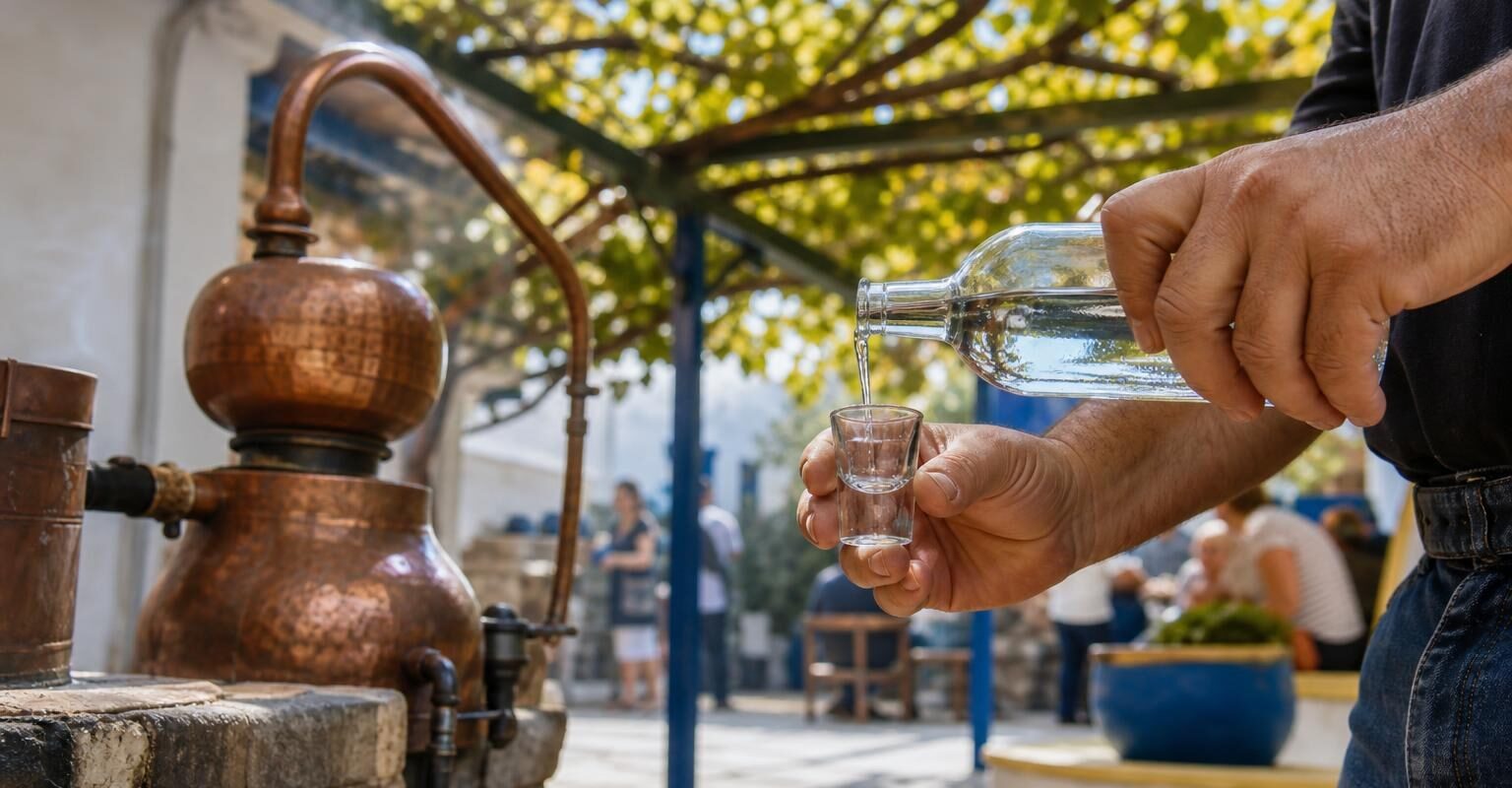
The traditional still is called a lampikos (or kazani in some villages), a copper pot still heated over a wood fire. The fermented pomace is loaded into the pot, water is added, and the mixture is slowly heated. As alcohol vapour rises, it passes through a copper coil submerged in cold water, condensing back into liquid. The first and last portions of the distillate are discarded: the “head” contains harmful methanol, while the “tail” carries off-flavours. Only the “heart” of the run is kept.
Modern licensed distilleries follow the same basic principle but use temperature controls and laboratory testing to ensure consistency. Village producers, however, still rely on experience, taste, and the colour of the flame to judge when the spirit is right. Watching a lampikos in action during a festival is one of the most authentic craft experiences you can have on the island.
Protected Status and the Art of Ageing
The EU’s 2004 geographical indication means that only spirits produced in Cyprus, from Cypriot grapes, using approved methods, can legally carry the zivania name. This protection sits alongside similar designations for products like Champagne or Feta, and it’s enforced across all EU member states.
Most zivania is consumed young and unaged, clear as water with a sharp, warming bite. Some producers, though, age their spirit in oak barrels for months or even years, producing a golden liquid with softer, more complex flavours: hints of vanilla, dried fruit, and toasted wood. Aged versions are sometimes labelled “old” or “reserve” and command higher prices.
Cyprus’s agricultural sector benefits from a €373 million Common Agricultural Policy Strategic Plan for 2023 to 2027, which supports rural development and agricultural competitiveness across the island. This funding helps sustain small-scale producers in the Troodos villages who might otherwise struggle to compete with larger commercial operations.
Tip: When buying bottles to take home, check the ABV on the label. Commercial bottles at 45% are widely available, but small-batch village productions may be stronger. UK customs allows you to bring spirits into the country for personal use, but quantities above your duty-free allowance will attract tax.
November in the Troodos: A Season of Celebration
Autumn in the Troodos Mountains is defined by falling temperatures, golden vineyards, and the sharp scent of wood smoke drifting from village stills. The distilling season runs roughly from late September through November, and several villages mark the occasion with public festivals that combine live demonstrations, food, music, and generous tastings.
These festivals are small-scale, community-run affairs: don’t expect stadium-sized events. Attendance typically ranges from a few hundred to a couple of thousand visitors, and the atmosphere is relaxed and welcoming. Most festivals are free to enter, with food and drink available for purchase at modest prices. Dates shift each year depending on the harvest and local organisation, so always confirm before making the drive.
The three most established festivals take place in Alona, Pelendri, and Pedoulas, all within the Troodos range but in different valleys and at different altitudes.
The Alona Zivania Festival: Tradition in the Pitsilia Region
Alona is a tiny village in the Pitsilia wine region, perched at around 1,100 metres above sea level. Its annual festival is one of the best-known celebrations of the spirit on the island. The 2026 edition is scheduled for Sunday, 25 October, running from 10:30 AM to 3:30 PM.
The programme typically includes live distillation demonstrations using a traditional lampikos, tastings of both young and aged spirits, and stalls selling local products: dried fruits, nuts, preserves, and fresh bread baked in outdoor ovens. Folk musicians and dancers perform throughout the day, and the village’s stone-built houses provide a striking backdrop.
Alona sits about 65 km from Limassol and roughly 80 km from Larnaca. The drive takes around an hour from either city, climbing through increasingly narrow roads as you approach the village. Parking is limited, so arrive early.
Pelendri: Celebrating the Grape Spirit in Style
Pelendri, another Pitsilia village at about 880 metres elevation, holds its own autumn festival celebrating local wine and spirits. The village is known for its UNESCO-listed Church of Timios Stavros, its vineyards, and its traditional architecture.
The Pelendri festival usually falls in late October or November, though exact dates for 2026 should be confirmed locally. Events typically include guided walks through the vineyards, cooking demonstrations featuring dishes prepared with the spirit, and live music. The village has a handful of tavernas that stay open late during festival weekends, making it a good option if you want to eat well and avoid driving afterwards.
From Limassol, Pelendri is approximately 55 km north, reachable in about 50 minutes via the B8 and local roads.
Pedoulas: Heritage and Hospitality in the Marathasa Valley
Pedoulas sits in the Marathasa Valley on the northern slopes of the Troodos range, at roughly 1,100 metres. It’s better known for its cherries in summer, but autumn brings its own celebration. The village’s Palouze and Zivania Festival in 2026 combines distilling demonstrations with the making of palouze, a traditional grape must pudding.
Pedoulas is about 70 km from Limassol and 90 km from Nicosia. The drive from Nicosia takes roughly 75 minutes, passing through Kakopetria and climbing steadily. The village has several guesthouses and small hotels, making an overnight stay practical and pleasant.
Getting There by Car: Navigating the Mountain Routes
A rental car is the only practical way to reach these villages, as public transport to the Troodos interior is extremely limited. The roads are paved throughout, but they’re narrow, winding, and often lack barriers on the mountain side. If you’re not accustomed to mountain driving, take it slowly and use your horn on blind corners.
| Route | From | Distance | Drive Time | Road Condition |
|---|---|---|---|---|
| To Alona | Limassol | ~65 km | ~60 min | Paved, narrow above 800 m |
| To Pelendri | Limassol | ~55 km | ~50 min | Paved, good condition |
| To Pedoulas | Nicosia | ~90 km | ~75 min | Paved, winding above Kakopetria |
| To Pedoulas | Limassol | ~70 km | ~65 min | Paved, steep sections |
Parking at festival villages is informal: usually a field or roadside area near the village centre. Arrive before 10:00 AM on festival days to secure a spot. If you’re renting a car through a provider like CyprusCarRental, confirm that your agreement covers mountain roads (most standard rentals do, but off-road tracks are typically excluded).
Note: Most rental agreements in Cyprus exclude off-road driving. Stick to paved roads, and be aware that rental insurance from the Republic of Cyprus does not cover the northern part of the island.
Important Safety and Seasonal Considerations
Late October and November bring cooler, wetter weather to the Troodos. Daytime temperatures at 1,000 metres typically hover between 8°C and 15°C, dropping close to freezing overnight. Rain is common, and early snowfall isn’t unusual above 1,400 metres by late November.
Pack accordingly:
- Warm layers and a waterproof jacket
- Sturdy shoes with grip (village paths can be muddy)
- A full tank of fuel: petrol stations are scarce above the foothills
- A charged phone with offline maps downloaded (mobile signal is patchy in the valleys)
If you’re visiting after mid-November, check whether snow chains are required on the highest roads. The Cyprus Police and local authorities post road condition updates, and some mountain routes close temporarily during heavy snowfall.
Weather Alert: Troodos mountain roads can become icy without warning in late November. Reduce your speed, keep headlights on, and avoid driving after dark on unfamiliar routes.
Traditional Uses Beyond the Glass: Medicine and Magic
Zivania’s role in Cypriot life extends well beyond casual drinking. The spirit has been a staple of Cypriot folk medicine for generations, used as a disinfectant for wounds, a chest rub for colds, and a warming tonic during the harsh mountain winters. Older residents of the Troodos villages still swear by a small glass before bed to ward off illness.
Beyond medicine, the spirit has practical household uses. It’s been employed as a cleaning agent, a fire starter, and even an insect repellent. During the colder months, shepherds traditionally carried a flask to warm themselves during long nights with their flocks.
There’s a social dimension too. Offering a glass of the spirit to visitors is a deeply rooted gesture of hospitality. Refusing it can cause mild offence in traditional settings, though most hosts understand if you explain you’re driving. The spirit also plays a role in religious and seasonal celebrations, particularly around Christmas and Easter, when it’s used in cooking and toasting.
Pairing Zivania with Local Meze and Delicacies
The spirit’s clean, sharp character makes it a natural companion for rich, salty, and fatty foods. Cypriot meze, served as a procession of small dishes, is the ideal pairing context.
Strong matches include:
- Halloumi: Grilled or fried, the salty cheese contrasts well with the spirit’s dryness
- Lountza: Smoked pork loin, thinly sliced, with a squeeze of lemon
- Sheftalia: Grilled pork sausages wrapped in caul fat
- Olives and capers: Sharp, briny flavours that complement the spirit’s intensity
- Palouze and soutzoukos: The grape must desserts served at festivals provide a sweet counterpoint
Sip it slowly between bites rather than knocking it back. The spirit is best served chilled or at room temperature in a small glass. At festivals, you’ll often see it poured from unmarked bottles alongside baskets of bread and bowls of olives: the simplest and arguably best way to enjoy it.
Frequently Asked Questions About Zivania
What does zivania taste like?
It’s a dry, clear spirit with a sharp, warming character. Young versions have a pronounced grape aroma and a fiery finish. Aged varieties are smoother, with notes of vanilla and dried fruit from oak contact. The taste is closer to Italian grappa than to ouzo or raki.
Can I buy zivania in the UK?
Some specialist importers and online retailers stock commercial Cypriot brands. Availability is limited compared to more mainstream spirits, so buying a bottle or two at the source is worthwhile. Check UK duty-free allowances if you’re flying home with it.
Is it safe to drink homemade zivania?
Village-produced spirit is generally safe when made by experienced distillers who discard the methanol-rich “head” of the run. However, there’s no laboratory testing involved, and alcohol content can be significantly higher than commercial bottles. Drink cautiously and in small quantities.
When are the 2026 festivals?
The Alona festival is confirmed for 25 October 2026. Pelendri and Pedoulas festivals typically fall between late October and mid-November, but exact dates vary each year. Check locally or with village community boards closer to the time.
Do I need a 4×4 to reach the festival villages?
No. All three villages are accessible via paved roads suitable for a standard rental car. Roads are narrow and winding but well-maintained. A 4×4 is only necessary if you plan to explore unpaved forest tracks, which most rental agreements prohibit anyway.
The Troodos distilling festivals offer a rare chance to experience a Cypriot tradition that hasn’t been polished for tourist consumption. The villages are small, the welcome is genuine, and the spirit itself is unlike anything you’ll find elsewhere in Europe. Plan your route, book a guesthouse if you intend to sample generously, and give yourself time to enjoy the mountain scenery on the drive up. The autumn light through the vineyards alone is worth the trip.