Table of Contents
- Can You Drive to Northern Cyprus in a Rental Car?
- Essential Vehicle Crossing Points for 2026
- Getting to the North by Car
- Compulsory North Cyprus Car Insurance
- Navigating the Ledra Palace and City Crossings
- Driving Rules and Regulations in the North
- Step-by-Step Guide to the Border Crossing Process
- Frequently Asked Questions
Yes, you can drive a rental car from the Republic of Cyprus into the north, but only if your rental company explicitly permits it. Most of the major international franchises don’t, and your southern insurance won’t cover you once you cross the Green Line. Getting this wrong could leave you personally liable for any damage, breakdown, or accident on the other side.
The good news is that the process itself is straightforward once you’ve sorted the paperwork. Crossings between the two sides reached a historic high of 7.79 million in the 2025-2026 period, and thousands of those journeys are made by tourists in rental vehicles every week. You’ll need the right rental agreement, separate insurance purchased at the border, and a basic understanding of the rules on the other side. This guide covers every step: which crossings accept vehicles, what the insurance costs, how the border process works, and what to expect on northern roads.
Important: The political situation in Cyprus is complex. This guide uses “the north” and “Northern Cyprus” as geographic references for practical travel purposes, without implying recognition of any political entity. We maintain a neutral, factual tone throughout.
Can You Drive to Northern Cyprus in a Rental Car?
The short answer is yes, but with conditions. Your ability to cross depends entirely on your rental company’s policy. Some local operators in the south allow it; most international brands do not. If you’re planning a day trip or longer stay in the north, this is the single most important thing to sort out before you pick up the keys.
Drivers must carry written permission from their rental provider. Without it, you risk voiding your entire rental agreement, including collision damage waiver and theft protection. If you’re renting through CyprusCarRental or another local agency, ask about cross-border permissions at the time of booking, not at the counter.
Rental Company Policies and Legal Restrictions
Most international rental franchises, including Sixt, Hertz, and Europcar, explicitly prohibit driving their vehicles across the Green Line. This isn’t just a suggestion buried in the small print: it’s a hard contractual restriction. Breach it, and you’ll be fully responsible for any costs that arise.
Some companies that do permit crossing will provide a specific cross-border permit or written authorisation within the rental contract. This document may be checked at the crossing point, so keep it accessible alongside your passport and driving licence.

Rental cars hired in Northern Cyprus face the reverse problem. They’re generally prohibited from crossing south due to a lack of registration and insurance reciprocity. The restriction works in both directions.
Pro Tip: Book with a local Cypriot agency that explicitly states cross-border travel is allowed. Confirm this in writing before your trip. Verbal assurances at the desk aren’t enough if something goes wrong in the north.
The Cyprus Green Line and Border Crossings
The Green Line is the UN-patrolled buffer zone that has divided Cyprus since 1974. It runs roughly east to west across the island, cutting through the capital Nicosia. Seven crossing points accept vehicles, though not all are equally convenient depending on your starting location.
Crossing is free for EU citizens and most international passport holders. You’ll show your passport or ID card at both the Republic of Cyprus checkpoint and the northern checkpoint. There’s no visa required, and the process typically takes between five and twenty minutes depending on traffic.
The crossings operate on set schedules, with most open 24 hours. However, queues can build during peak holiday periods and weekends, particularly at the Nicosia crossings.
Essential Vehicle Crossing Points for 2026
Seven crossing points currently accept motor vehicles. The table below lists each one with its nearest city on each side and practical notes for drivers.
| Crossing Point | South Side (Nearest City) | North Side (Nearest City) | Notes |
|---|---|---|---|
| Agios Dometios / Metehan | Nicosia (2 km) | North Nicosia (1 km) | Busiest crossing; urban traffic |
| Ledra Palace | Nicosia (old town) | North Nicosia (old town) | Vehicles and pedestrians; central |
| Pergamos / Beyarmudu | Pergamos (0.5 km) | Beyarmudu (0.5 km) | Rural, quieter option |
| Zodia / Bostancı | Morphou direction | Güzelyurt (15 km) | Western route to Morphou Bay |
| Kato Pyrgos / Limnitis | Kato Pyrgos (1 km) | Yeşilırmak (1 km) | Remote northwest; scenic route |
| Strovilia | Dhekelia (5 km) | Famagusta direction | Via British Sovereign Base Area |
| Deryneia / Akyar | Deryneia (1 km) | Famagusta (15 km) | Eastern route; opened 2018 |
The Agios Dometios/Metehan crossing handles the highest volume of vehicle traffic and is the most commonly used by tourists based in Nicosia or heading to Kyrenia. For those staying in Larnaca or Ayia Napa, the Strovilia or Deryneia crossings save considerable driving time.
Note: Crossing point hours and vehicle access can change. Check locally before setting out, especially if you’re using one of the quieter rural crossings like Kato Pyrgos/Limnitis.
Getting to the North by Car
Your route depends on where you’re starting. Here are the most common journeys:
From Larnaca to Famagusta (via Deryneia crossing)
- Distance: approximately 75 km
- Drive time: 1 hour 15 minutes (including border)
- Road condition: paved motorway to Deryneia, then two-lane roads after crossing
- Parking: available in Famagusta old town (paid lots near Othello Tower)
From Limassol to Kyrenia (via Agios Dometios crossing)
- Distance: approximately 150 km
- Drive time: 2 hours 15 minutes (including border)
- Road condition: motorway to Nicosia, then mountain road over the Pentadaktylos range
- Parking: street parking and small lots in Kyrenia harbour area
From Paphos to Morphou (via Zodia crossing)
- Distance: approximately 170 km
- Drive time: 2 hours 30 minutes (including border)
- Road condition: motorway to Nicosia area, then rural roads after crossing
The drive from the south to any crossing point is on well-maintained motorways. Once you cross, road quality varies. Main routes between Kyrenia, Famagusta, and North Nicosia are in reasonable condition. Side roads and rural tracks can deteriorate quickly, and most rental agreements exclude off-road driving entirely.
Compulsory North Cyprus Car Insurance
Your Republic of Cyprus car insurance does not cover you in the north. This is non-negotiable. You must purchase separate third-party insurance at the crossing point before entering.
As of mid-2026, the costs are:
- 3 days: approximately €20
- 1 month: approximately €35
- 3 months: approximately €70
You buy this at small kiosks located just past the northern checkpoint. Payment is usually in euros or Turkish lira. The process takes a few minutes, and you’ll receive a paper certificate to keep in the car.
Understanding the Limits of Third-Party Cover
The insurance you buy at the border is basic third-party cover only. It pays for damage you cause to other people or their property. It does not cover damage to your own rental car, theft, fire, or personal injury to you or your passengers.
This means if you scrape a wall in Kyrenia’s narrow streets or hit a pothole that damages a tyre, you’re paying out of pocket. Your southern collision damage waiver and comprehensive cover stop at the Green Line.
Some travellers purchase separate travel insurance policies that include vehicle excess cover abroad. If you’re planning to spend several days driving in the north, this is worth investigating before your trip.
The Lack of Breakdown and Recovery Support
This is the detail most people overlook. Southern roadside assistance providers are legally unable to operate or send recovery trucks into Northern Cyprus. If your car breaks down, you can’t call the RAC or your rental company’s assistance line and expect a truck to arrive.
You’ll need to arrange local help. Northern Cyprus has its own garages and tow services, but communication can be a challenge if you don’t speak Turkish. Save a few local numbers in your phone before crossing, and carry enough cash to cover an unexpected tow.
Warning: If your rental car suffers mechanical failure or significant damage in the north, you may need to arrange and pay for repairs or towing independently. Your rental company’s roadside assistance almost certainly won’t cross the border.
Navigating the Ledra Palace and City Crossings
The Ledra Palace crossing sits in the heart of Nicosia’s old town, within the Venetian walls. It handles both pedestrian and vehicle traffic, though the road is narrow and can feel congested during busy periods.
For drivers, the approach from the south is via Markos Drakos Avenue. Follow signs for the UN buffer zone. You’ll pass through the Republic’s checkpoint first, then drive through a short stretch of the buffer zone before reaching the northern checkpoint. The whole crossing area is only a few hundred metres long.
The nearby Agios Dometios/Metehan crossing, about 3 km west, is wider and better suited to cars. If you’re simply passing through Nicosia to reach Kyrenia or the coast, Agios Dometios is the faster, less stressful option. Ledra Palace works well if you’re already in the old town or want to park and explore both sides on foot.
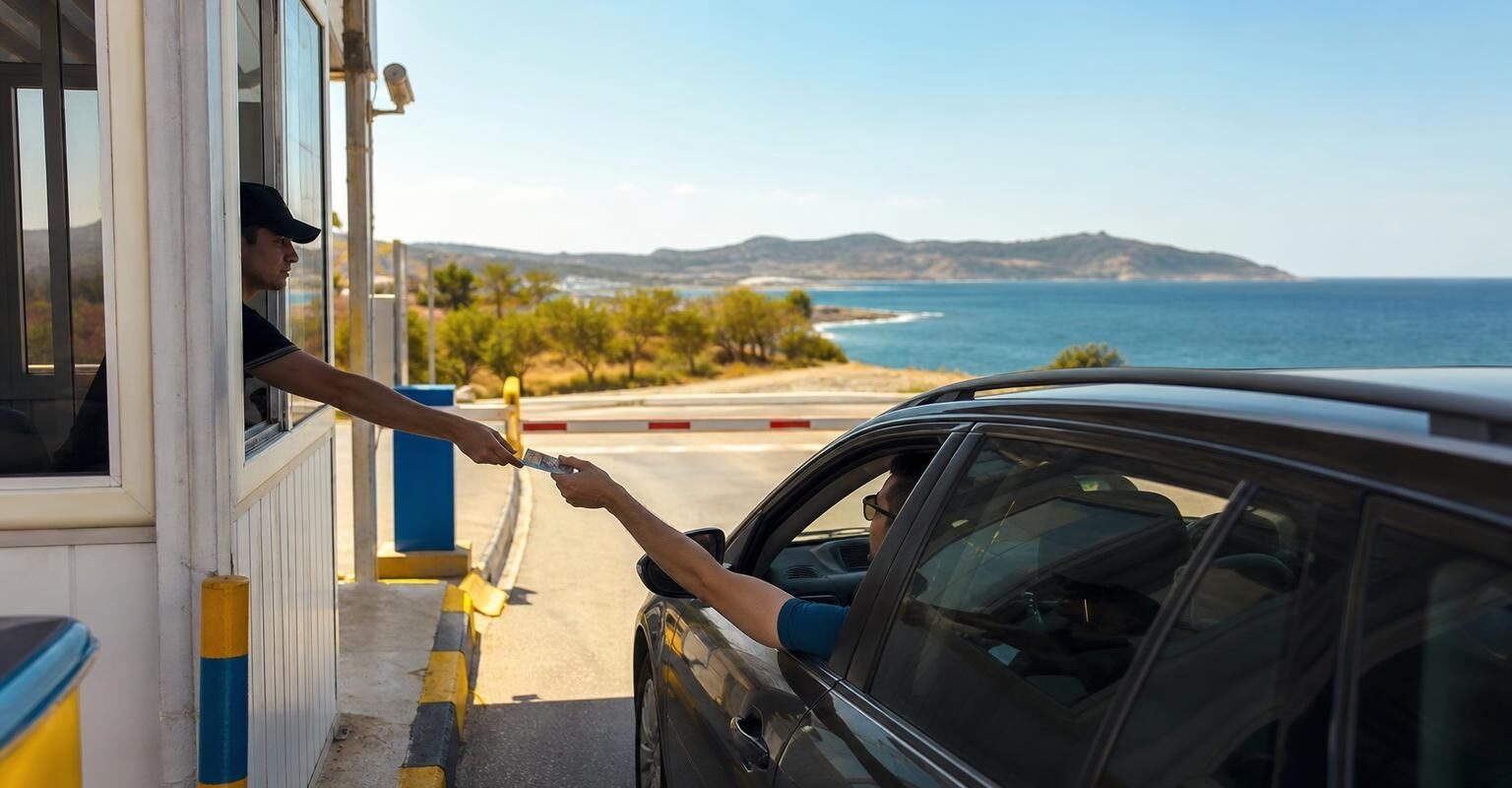
Expect passport checks at both ends. Keep your documents, rental agreement, and cross-border permit within easy reach. Border officials may also glance at your insurance certificate on the northern side.
Driving Rules and Regulations in the North
Northern Cyprus drives on the left, the same as the south and the UK. This makes the transition straightforward for British visitors. Road signs are in Turkish and sometimes English, though coverage of English signage decreases outside main tourist areas.
Key rules for 2026:
- Speed limits: 50 km/h in towns, 80 km/h on open roads, 100 km/h on dual carriageways
- Seatbelts: compulsory for all occupants
- Mobile phones: prohibited while driving unless using hands-free
- Blood alcohol limit: 0.05% (lower than the UK’s 0.08%)
- Headlights: must be used in tunnels and during poor visibility
- Children under 12: must sit in the rear
Speeding fines are calculated based on the gross minimum wage, and they’re not trivial. Exceeding the limit by 20-40 km/h results in a fine of approximately 10,634 TL (roughly €280 in 2026). Police checkpoints are common on the Kyrenia-Famagusta highway.
GPS navigation works in the north, though some mapping apps show limited detail for smaller roads. Download offline maps before crossing, as mobile data roaming charges may apply differently in the north compared to the south.
Pro Tip: Fuel is generally cheaper in the north than the south. Fill up after crossing if your tank is low. Petrol stations accept euros, Turkish lira, and sometimes credit cards, though cash is more reliable at rural stations.
Step-by-Step Guide to the Border Crossing Process
Here’s exactly what happens when you drive across, using the Agios Dometios/Metehan crossing as an example:
- Approach the Republic of Cyprus checkpoint. Join the vehicle queue.
- Present your passport or EU ID card to the officer. They may ask your destination.
- Drive through the UN buffer zone (a short stretch of road, usually under 500 metres).
- Arrive at the northern checkpoint. Present your passport again.
- The officer will stamp a separate slip of paper, not your passport. Keep this slip safe for your return.
- Stop at the insurance kiosk just past the checkpoint. Purchase your third-party cover.
- You’re through. Follow road signs to your destination.
On return, the process reverses. You’ll show your passport at the northern exit, drive through the buffer zone, and present it again at the Republic’s checkpoint. The insurance slip and entry paper may be checked.
The whole process rarely takes more than 15-20 minutes outside peak times. During summer weekends and public holidays, allow 30-45 minutes at busier crossings like Agios Dometios.
Keep these documents accessible throughout your trip:
- Valid passport or EU ID card
- Driving licence (UK or international)
- Rental agreement with cross-border permission
- Northern Cyprus insurance certificate
- Entry slip from the northern checkpoint
Frequently Asked Questions
Can I take any rental car across the Green Line?
No. Most international rental companies prohibit it. You need a local agency that explicitly allows cross-border travel and provides written authorisation. Always confirm this before booking, not at the pickup counter.
Is my southern car insurance valid in the north?
It isn’t. You must buy separate third-party insurance at the crossing point. As of 2026, this costs approximately €20 for three days. The cover is basic and does not include damage to your own vehicle.
Do I need a visa to cross into the north?
EU citizens and most international passport holders do not need a visa. You’ll receive a paper entry slip at the northern checkpoint. There’s no stamp placed in your passport.
What happens if my rental car breaks down in the north?
You’ll need to arrange local assistance. Southern breakdown services cannot operate across the border. Save local garage numbers before crossing and carry cash for any towing or repair costs.
Can I drive a Northern Cyprus rental car into the south?
Generally no. Northern-registered vehicles lack the insurance and registration reciprocity needed to enter the Republic of Cyprus. The restriction applies in both directions.
Driving a rental car to Northern Cyprus is entirely doable with the right preparation. The key steps are simple: choose a rental company that permits crossing, buy insurance at the border, and carry your documents. The roads are manageable, the crossings are efficient, and you’ll have the freedom to explore Kyrenia, Famagusta, and the Karpaz Peninsula at your own pace.
Don’t leave the cross-border question until you’re at the rental desk. Sort your permissions and understand the insurance gaps before you arrive in Cyprus. A little planning turns what looks like a complicated border crossing into a straightforward part of your trip.