
Table of Contents
- Exploring Ancient Kourion: A Coastal Jewel on the Road to Paphos
- Getting There by Car
- The Kourion Amphitheatre and Epic Coastal Vistas
- Mosaics and Mansions: The House of Eustolios
- The Sanctuary of Apollo Hylates: Worship in the Woodland
- Relaxing at Kourion Beach: Sun, Surf, and Seafood
- Nearby History: A Detour to Kolossi Castle
- Planning Your Visit: Tickets, Timing, and Practical Tips
- The Ideal Limassol Day Trip Itinerary
- Frequently Asked Questions
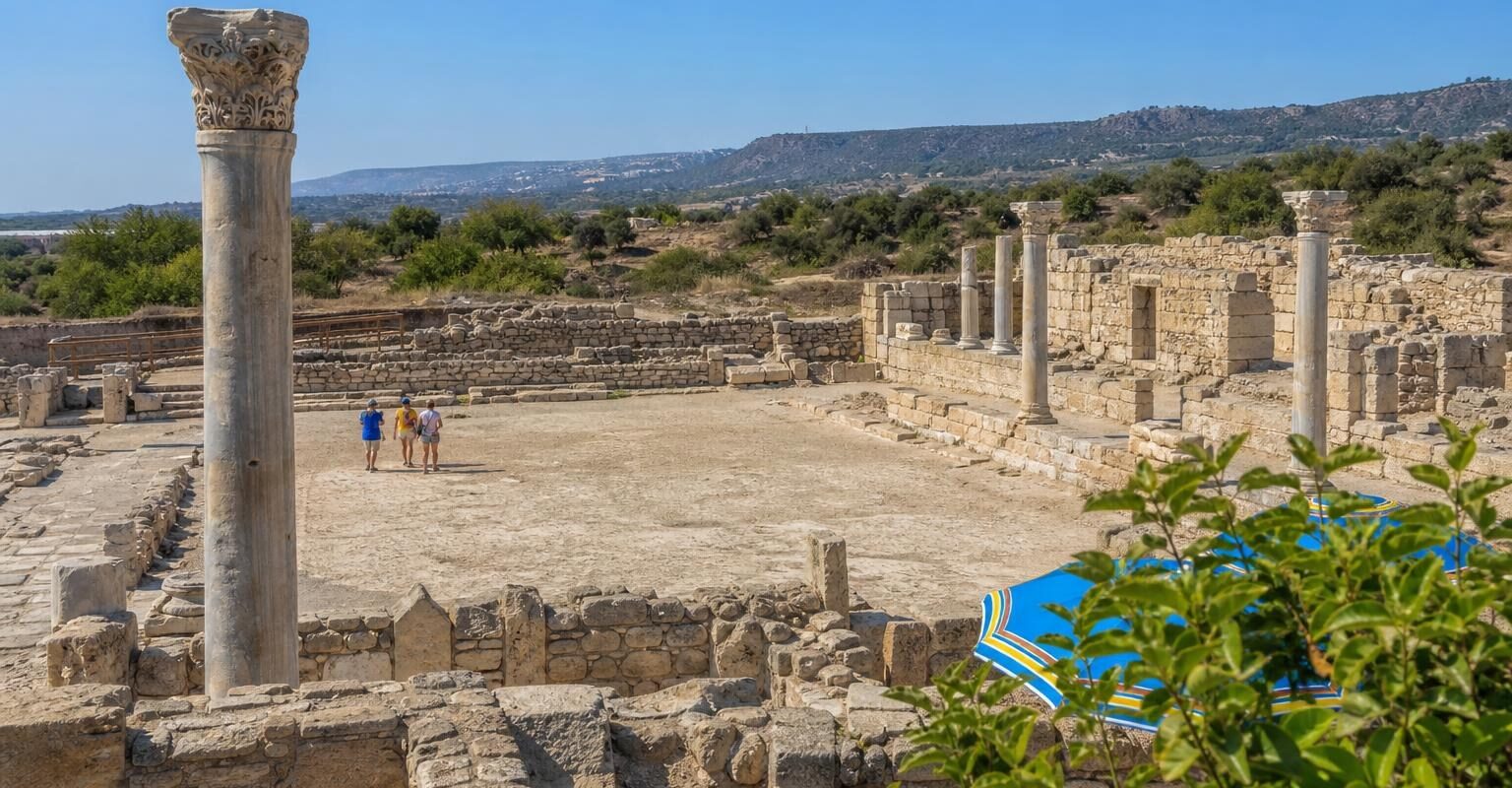
Perched on dramatic limestone cliffs about 70 metres above the Mediterranean, the ancient city-kingdom of Kourion is one of Cyprus’s most striking archaeological sites and a natural stopping point on the drive between Limassol and Paphos. The ruins span roughly 3,000 years of history, from the Mycenaean period through the Roman and early Christian eras, and they’re set against a coastal panorama that makes every photo look professionally composed. Whether you’re spending a full day or fitting it into a broader road trip, the site rewards visitors with a restored Greco-Roman amphitheatre, intricate floor mosaics, and the nearby Sanctuary of Apollo Hylates, all within a short drive of one another. Below the cliffs, a long stretch of sand and pebble beach offers a welcome cool-down after hours of walking in the sun.
Exploring Ancient Kourion: A Coastal Jewel on the Road to Paphos
The city-kingdom of Kourion was founded by Mycenaean Greek settlers around the 13th century BC and grew into one of the most powerful city-states on the island. It thrived under successive Greek, Ptolemaic, and Roman rulers before a catastrophic earthquake in 365 AD levelled much of the city. Early Christian settlers rebuilt parts of it, but by the 7th century the population had largely moved inland.
What survives today is remarkably well-preserved, partly because the site was never built over by later civilisations. The Cyprus Deputy Ministry of Culture completed a €3.5 million infrastructure upgrade in 2025, including a reconstructed Visitor Centre and new protective membranes over the ancient mosaics. Braille signage and specialised wooden surfaces in the ancient theatre now accommodate wheelchair users, making the site more accessible than it’s ever been.
The site is treated not simply as a static monument but as a living cultural space where heritage protection meets modern visitor experience. A digital initiative launched in late 2026 uses AI and 3D reconstructions to recreate ancient athletic competitions at the Kourion stadium, giving visitors an immersive sense of what the site looked like in its prime.
Getting There by Car
The archaeological site sits about 19 km west of Limassol’s old town, just off the A6 motorway that connects Limassol to Paphos. The drive takes roughly 20 minutes in normal traffic.
| Detail | Info |
|---|---|
| Starting point | Limassol old town or tourist area |
| Distance | ~19 km |
| Drive time | 20-25 minutes |
| Road type | Paved motorway (A6), then well-signed exit |
| Parking | Free car park at the main entrance |
| Seasonal notes | Busy mid-morning in summer; arrive early or late afternoon |
Exit the A6 at the sign for Kourion/Episkopi and follow the brown heritage signs uphill. The road is fully paved and suitable for any rental car. A separate car park serves the Sanctuary of Apollo Hylates about 3 km further west along the same road.
Tip: If you’re driving from Paphos, the site is about 65 km east along the A6, roughly a 45-minute drive. It makes a logical first or last stop on a Limassol-Paphos road trip. Having your own car is almost essential here, as public transport to the site is infrequent and unreliable.
Keep in mind that most rental agreements in Cyprus exclude off-road driving, and insurance from Republic of Cyprus agencies typically doesn’t cover travel to the north of the island. Neither issue applies to this route, which is entirely on paved roads in the south.
The Kourion Amphitheatre and Epic Coastal Vistas
The Greco-Roman theatre is the first thing most visitors see, and it’s the image that appears on half the postcards of the Limassol district. Originally built in the 2nd century BC, it was expanded during the Roman period to seat around 3,500 spectators. Earthquakes damaged it repeatedly, and the structure was carefully restored in the 1960s and 1970s.
Today the Kourion amphitheatre hosts live performances during the summer months, including Shakespeare plays, concerts, and the annual Kourion Music Festival. Sitting in the upper tiers at sunset, with the Mediterranean stretching out below, is one of those rare experiences where the setting genuinely outshines whatever’s on stage. The acoustics remain impressive: a coin dropped on the orchestra floor can be heard from the back row.
The theatre’s orientation is unusual. Most ancient theatres face a hillside, but this one opens directly toward the sea, which means performers competed with one of the finest backdrops in the ancient world. Walk to the edge of the cliff path beyond the theatre and you’ll see the coastline curving away toward Paphos in one direction and Limassol in the other.
Mosaics and Mansions: The House of Eustolios
A short walk east of the theatre brings you to the House of Eustolios, a late Roman public building that served as a bathhouse and social gathering place. The structure dates to the 5th century AD and was built after the devastating earthquake of 365 AD, making it one of the site’s newer constructions.
The star attraction here is the floor mosaics, which are among the finest on the island. Protected under modern shelters with the new membranes installed during the 2025 upgrade, the mosaics depict fish, birds, and personifications of Ktisis (Creation). Inscriptions in Greek welcome visitors and invoke Christ, reflecting the transition from pagan to Christian culture that was underway when the building was constructed.
Don’t rush through this section. The mosaics are intricate and reward close inspection. Look for the panel showing a female figure holding a measuring rod, widely interpreted as Ktisis. The building’s layout also reveals how Roman bathing culture worked: you can trace the path from the frigidarium (cold room) through the tepidarium (warm room) to the caldarium (hot room), with underfloor heating channels still visible.
The Sanctuary of Apollo Hylates: Worship in the Woodland
About 3 km west of the main archaeological site, the Sanctuary of Apollo Hylates was one of the most important religious centres in ancient Cyprus. Apollo was worshipped here as Hylates, meaning “of the woodland,” and the sanctuary functioned from the 8th century BC until the 4th century AD, when Christianity supplanted the old religions.
The sanctuary occupies a hillside surrounded by scrubby pine and carob trees, and it feels distinctly different from the exposed clifftop ruins of the main site. It’s quieter, shadier, and easier to explore at a relaxed pace. The site had a dual function: religious worship and athletic training, which explains the mix of temples, altars, and sports facilities spread across the precinct.
Architectural Highlights of the Temple
The Temple of Apollo itself was a modest structure by mainland Greek standards, but its remains give a clear picture of Cypriot temple architecture. Partially reconstructed columns mark the entrance, and the foundations show a typical Cypriot plan with a central cella (inner chamber) where the cult statue stood.
A circular monument near the temple, known as the Archaic Altar, dates to the 7th century BC and is one of the oldest surviving structures in the sanctuary. Fragments of votive offerings, terracotta figurines, and pottery found here are now displayed in the Limassol District Archaeological Museum.
The Sacred Precinct and Palaestra
The palaestra, a colonnaded courtyard used for athletic training, sits at the lower end of the sanctuary. Young men trained here as part of their religious and civic duties, and the space would have been filled with sand for wrestling and other exercises.
A long stoa (covered walkway) connected the palaestra to the upper sanctuary, creating a processional route that pilgrims followed during festivals. The stoa’s column bases are still in place, and you can walk the route yourself in about five minutes. Near the palaestra, look for the remains of a large storage building where pilgrims’ offerings were kept.
Note: The Sanctuary of Apollo has its own car park and entrance, so you’ll need to drive or walk between it and the main Kourion site. Allow at least 45 minutes to explore the sanctuary properly.
Relaxing at Kourion Beach: Sun, Surf, and Seafood
Below the cliffs of the archaeological site, Kourion Beach stretches for about 1 km along the coast. It’s a mix of dark sand and fine pebbles, backed by the dramatic chalk cliffs that give the area its character. The beach is popular with windsurfers and kitesurfers thanks to consistent afternoon breezes, and the water is clean and clear.
Access is via a separate road that winds down from the main highway near the Episkopi junction. There’s a free car park at the western end of the beach. A couple of tavernas serve grilled fish, meze, and cold Keo beer right on the sand, making it easy to spend a lazy afternoon after a morning at the ruins.
The beach is a designated turtle nesting area, and sections may be cordoned off during nesting season (roughly June to August). Lifeguards are present during summer, and there are basic facilities including showers and changing areas.
Important: The path from the archaeological site to the beach is steep and not directly connected. Don’t try to scramble down the cliffs. Drive down to the beach car park instead; it’s about a 5-minute drive.
Nearby History: A Detour to Kolossi Castle
If you’re heading back toward Limassol after visiting the ruins, a quick detour to Kolossi Castle adds another layer to the day. The castle sits about 14 km east of Kourion, just off the B6 road, and the drive takes roughly 15 minutes.
Built in the 13th century by the Knights of St John, Kolossi is a compact, well-preserved medieval tower that served as the headquarters for the production of Commandaria, the sweet dessert wine that’s been made in Cyprus for over 800 years. The three-storey keep offers views across the surrounding citrus groves and vineyards, and the old sugar refinery next door hints at the castle’s commercial importance.
Tickets are inexpensive and the visit takes about 30 minutes. It pairs well with a morning at the ancient ruins, offering a contrast between classical antiquity and medieval Crusader history.
Planning Your Visit: Tickets, Timing, and Practical Tips
A visit to the archaeological site and the Sanctuary of Apollo requires separate tickets, though both are affordable. Prices and hours can change from year to year, so check the Cyprus Department of Antiquities website or the ticket office before you go.
Managing the Cyprus Heat and Shade
The main archaeological site is almost entirely exposed, with very little natural shade. Summer temperatures regularly exceed 35°C between June and September, and the reflected heat off the limestone can make it feel even hotter.
- Bring at least 1.5 litres of water per person
- Wear a wide-brimmed hat and apply sunscreen before you arrive
- Sturdy shoes are essential: the terrain is uneven stone and gravel
- Visit early morning (opening time) or after 4 pm to avoid peak heat
- The Sanctuary of Apollo is slightly cooler thanks to tree cover
Weather Alert: Midday visits in July and August can be genuinely uncomfortable. Heatstroke is a real risk on exposed sites. If you’re visiting with children or elderly travellers, plan for the cooler hours and take breaks in the Visitor Centre, which is air-conditioned.
Opening Hours and Entrance Fees
Opening hours vary by season. As a general guide, the site opens at 8:00 or 8:30 am and closes between 5:00 pm (winter) and 7:30 pm (summer). The Sanctuary of Apollo follows similar hours. Ticket prices for 2026 should be confirmed locally, as the Department of Antiquities adjusts them periodically. Expect to pay a modest fee for each site, with discounts for students.
Allow roughly 1.5 to 2 hours for the main archaeological site and 45 minutes to an hour for the Sanctuary of Apollo. If you’re adding Kourion Beach and Kolossi Castle, plan for a full day.
The Ideal Limassol Day Trip Itinerary
This route works well as one of the best Limassol day trips, combining archaeology, beach time, and medieval history in a single outing. Here’s a suggested schedule:
- Depart Limassol by 8:30 am and drive to the Kourion archaeological site (20 minutes)
- Explore the theatre, House of Eustolios, and basilica ruins (1.5-2 hours)
- Drive 3 km west to the Sanctuary of Apollo Hylates (45 minutes)
- Head to Kourion Beach for a swim and a seafood lunch (1.5-2 hours)
- On the return, stop at Kolossi Castle (30 minutes)
- Arrive back in Limassol by mid-afternoon
This itinerary fits comfortably into a day, even with a leisurely pace. Having a rental car makes the logistics straightforward, as each stop is only a few minutes’ drive from the last. If you’re renting through a local provider like CyprusCarRental, you can pick up in Limassol and return the same evening.
Archaeologists recently identified a previously unknown Roman temple in the Latsithkia area near the site, featuring monumental columns approximately 5.07 metres tall. While this area isn’t yet open to the public, it’s a reminder that the region still has surprises to offer, and future visits may include entirely new sections to explore.
Frequently Asked Questions
How long does it take to visit Kourion?
Budget 1.5 to 2 hours for the main archaeological site. Add another 45 minutes to an hour for the Sanctuary of Apollo Hylates. If you include the beach and Kolossi Castle, you’re looking at a full day.
Is there shade at the archaeological site?
Very little. The main ruins are on an exposed clifftop with almost no tree cover. The recently upgraded Visitor Centre is air-conditioned, and the Sanctuary of Apollo has more shade from surrounding trees. Bring water, sunscreen, and a hat regardless of the season.
Can I visit Kourion without a car?
Technically yes, but it’s difficult. Public buses from Limassol run infrequently and don’t connect the main site to the Sanctuary of Apollo or the beach. A rental car or taxi is the most practical option. Organised tours from Limassol are also available but limit your flexibility.
Are the ruins accessible for wheelchair users?
Accessibility has improved significantly. The 2025 upgrade introduced specialised wooden surfaces in the theatre area and Braille signage throughout the site. Some sections remain challenging due to uneven terrain, but the main highlights, including the theatre and House of Eustolios, are now reachable.
Is Kourion worth visiting in winter?
Absolutely. Winter temperatures hover between 12°C and 18°C, making it far more comfortable for walking. The site is quieter, and the light is softer for photography. Just check the reduced winter opening hours before you set off.
Cyprus recorded a record-breaking 4.53 million international tourist arrivals in 2025, and sites like Kourion are a major reason why. The combination of ancient history, coastal scenery, and easy access from Limassol makes this stretch of coastline one of the most rewarding half-day drives on the island. Pack early, bring plenty of water, and give yourself time to linger. The ruins have stood here for millennia; they deserve more than a rushed visit.